

This is a question that will be familiar to many of us. I’ve certainly been asked it many times - it’s a delicate question that needs sensitive handling.
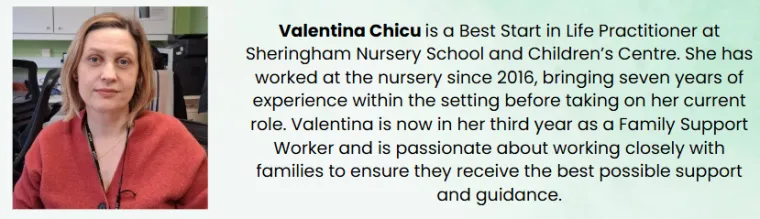
As a Family Support Worker, I’ve worked with Nick and his son Alex as part of the Early Help Team - I provide help to parents who need support with their child’s learning and development or concerns such as housing and accessing benefits.
Nick approached me one day, wanting some help.
I found a quiet space for Nick and me to have a conversation. Alex was playing with the cars as we spoke.
Nick: I’m concerned about Alex’s speech – he’s not talking to us.
Valentina: Ok, can you give me an example of what he says or does when he wants something?
Nick: He usually gets hold of my hand or points towards what he wants - I have to guess exactly what.
Valentina: Well, this Alex’s way of communicating with you. He’s able to let you know when he wants something. It’s good that he can do this.
Nick: Yes, I see that and get him what he wants. But I really want him to use words. Is there anything we can do to help him?
Valentina: Yes, you can try doing what we do here.
So, when he takes your hand and points towards something, you can get down to his level (I demonstrate) and say what he’s doing, something like, “I think you want the car, Alex?” If he shows you that it’s not the car that he wants, you can then name the other objects that he seems to be pointing to until it’s the one he wants. This will help Alex make a connection between gestures, objects and words.
Nick: The thing is he cries and gets so frustrated, throwing the toys about when I don’t understand. Sometimes, it’s so hard to understand him and it makes me upset.
Valentina: I think I understand something of how you feel - it’s hard for both of you. Try to stay as calm as you can - this will help Alex. And, as I said, try what we do here and see if things improve a little.
Nick: How long will I have to do this before he starts using words?
Valentina: Well, the best way to help him is to use this strategy all the time – so during mealtimes, when he’s playing, when you’re getting him dressed and so on.
Nick: Could you show me how to do it with Alex - I’m not very good at this sort of thing!
Valentina: Well, it takes time and practice for all of us – it’s not easy at first but the more you do it, the better it should be for both of you.
I go over to Alex and sit down nearby. I assess whether he’s comfortable with me being there. Seeing that he is, I carefully join in with his play. While Alex is playing, I comment on it, “Alex, you have a car, vroom!” This got Alex’s attention and he started to respond by making sounds.
I replied with a similar sound.
I explained to Nick what I’d done and why. He was pleased to have something to try, and we arranged a catch-up for the following week.
How do I use research evidence to inform my work with Nick?
I used the Sharing Attention (Sh) strategy of the evidence-based ShREC approach: this showed Alex that the I was interested in him and what he was doing.
I then used the Respond (R) strategy by narrating Alex’s play - putting words to his play will help Alex’s language development. Responding to him shows that I’m interested and want to communicate with him.
At Sheringham Nursery School and Children’s Centre, we use our professional knowledge of the child, alongside the ShREC approach, to guide our interactions. I wanted to share these two strategies with Nick so that we could start to develop some consistency between nursery and home. I was sure to say that it’s not easy but takes time and practice. Julian Grenier highlights this in his blog:
“Experienced practitioners can make high-quality interactions look natural and effortless. But they are not easy to do well.” (EEF 2024)
In line with our approach at Sheringham, I give a lot of time to working closely with Nick, making parental support central to Alex’s learning and development. As it says in the EEF guidance report, ‘Parents play a crucial role in supporting their children’s learning, and levels of parental engagement are consistently associated with better academic outcomes’.
Evidence from the EEF’s Teaching and Learning Toolkit suggests that effective parental engagement can lead to learning gains of +4 months over the course of a year.
I will continue to use the ShREC strategies with Alex and share them with Nick. Over time, this should help Nick and Alex’s communication and help to address the question he came to me with.
Reflective Questions
- Think about when a parent last asked for your support with their child’s verbal language – how did it go?
- How might you use the ShREC approach with one of your children who is non-verbal?
Want to know more?
Education Endowment Foundation (2021) ‘Working with Parents to Support Children’s Learning’ (Guidance report)
EEF (2025) Improving early education through high-quality interactions
James, F (2025): The ShREC approach : 4 evidence-informed strategies to promote high-quality interactions with young children.