

Parent Involvement in Children’s Learning at the Pen Green Centre:
Parental engagement has long been recognised as a critical factor in children's early development, with growing evidence pointing to the long-term impact of a child's home environment on their learning outcomes. The Pen Green Centre for Children and Families in Corby is a beacon of best practice in this domain, this blog explores how the Pen Green Centre effectively engages parents in their children's learning and the evidence underpinning their success.
I have been a huge advocate for engaging with parents in a meaningful way for many years, having worked with families in our own centre and also working with colleagues in Midlothian where we rolled out training for over 75 settings to support them to embed this approach.
The Power of Parental Engagement in Early Years
Parental engagement, particularly in the early years can have a significant and positive impact on children’s cognitive development and academic success. The Early Years Toolkit (EEF, 2025) highlights that high-quality parental engagement can lead to progress in communication and language development, self-regulation, and early literacy and numeracy skills.
Evidence suggests that the most impactful strategies are those that support parents in understanding how children learn and in adopting behaviours that promote learning at home. These strategies are particularly effective when they are co-designed with parents and embedded in trusting, reciprocal relationships, principles that are at the heart of the Pen Green Centre’s work.
The Pen Green Model: Building Trust and Partnership
At the core of Pen Green’s philosophy is the principle of working in genuine partnership with parents. Easen et al (1992) describe this as a developmental partnership and see it as essential. Staff recognise that parents are experts on their children and work alongside them as co-educators. This goes beyond traditional notions of parental involvement (e.g. attending meetings or reading to children at home) and involves deep collaboration where parents actively contribute to, and shape their child’s learning journey.
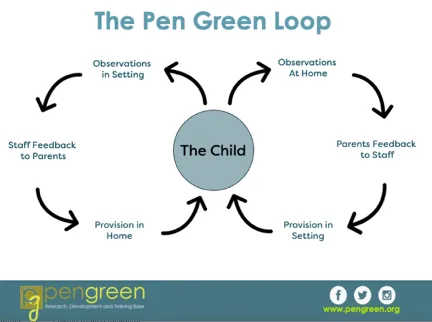
A key tool used at Pen Green is the Parental Involvement in Children’s Learning (PICL) approach (Whalley, 2017; Whalley et al, 2013: Gallagher, 2018). Through PICL, parents are visited at home to be welcomed to the nursery community, introduced to child development theory through sessions referred to as ‘key concept sessions’ engaged with in daily conversations about their child and are encouraged to observe, reflect on, and document their children’s learning at home. Practitioners support this process by sharing their own observations and learning narratives from the nursery, fostering a two-way dialogue grounded in mutual respect. This is referred to as the Pen Green Loop (See image)
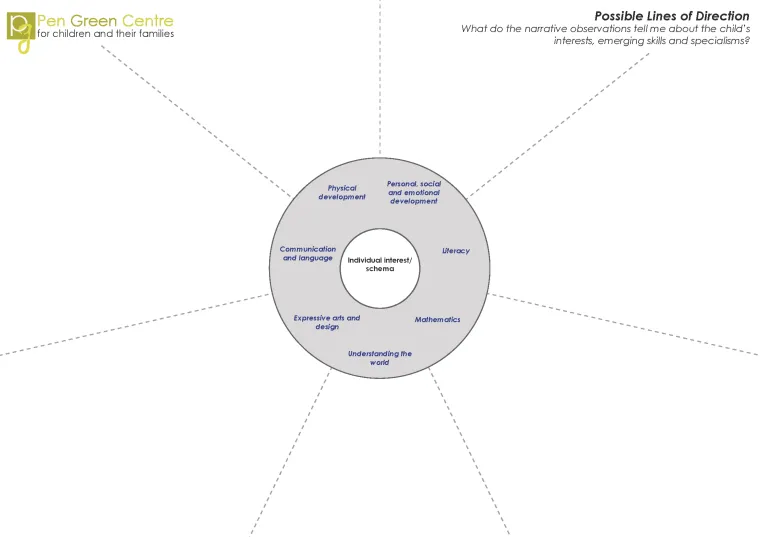
The information shared is developed and used to inform planning for the individual child. This process allows for the co-construction of an individual plan referred to as a PLOD (Possible Line of Direction) (See image)
Drawing on the work of Carr & Lee (2012) the observations come together, and the practitioner & parent write a learning story which helps show the links between home and the nursery, enabling both to see the value of everyday interactions and routines as learning opportunities. For example, a parent may share that their child has been really keen to play hide and seek at home, they are just settling in at nursery, and the practitioner is able to explore with the parent if this is about being here and being gone? Together the practitioner and parent think about ways they can explore this with the child and come up with a plan about using stories about going to nursery and building dens to further explore the idea of not being seen. You can see how the loop is in action here, and then how aspects can be included in the child’s individual PLOD
The Early Years Toolkit (EEF 2025) outlines that effective parental engagement strategies often include:
- Targeted communication that is clear and practical.
- Building parental skills and confidence in supporting learning at home.
- Personalised approaches that respond to families’ unique contexts.
- Developing relationships over time through consistent and empathetic engagement.
Through the PICL Approach communication is tailored and respectful, recognising that families have differing levels of confidence, time, and resources. Staff invest time in building strong relationships through home visits, regular one-to-one conversations, and accessible workshops. These relationships, in turn, foster the trust needed to co-construct learning strategies that resonate with families' lived realities.
The Centre’s practice also aligns with the EEF’s emphasis on sustained engagement. Rather than short-term interventions, Pen Green supports families over time, often beginning with antenatal support and continuing through the early years. This longitudinal approach allows for consistent relationship-building and deep understanding of each family’s evolving needs.
Impacts and Lessons
The outcomes of this approach are powerful. Children attending Pen Green show strong progress in their social, emotional, and cognitive development. Parents report increased confidence in supporting their children’s learning and often develop a deeper understanding of child development themselves.
Moreover, this model challenges the deficit view that can sometimes underpin parental engagement strategies—especially in disadvantaged communities. By positioning parents as capable, knowledgeable, and essential to the learning process, Pen Green fosters a culture of dignity, empowerment, and shared responsibility.
Carr. M., & Lee. W., (2012) Learning Stories Constructing Learning Identities in Early Education. London, Sage Publications.
Easen, P., Kendall. P., & Shaw. J., (1992) Parents and Educators: Dialogue and Development Through Partnership. Children and Society 6 (4) PP282-296.
Education Endowment Foundation Early Years Toolkit https://educationendowmentfoundation.org.uk/education-evidence/teaching-learning-toolkit/parental-engagement
Whalley, M., (2017) Involving Parents in their Children’s Learning. 3rd Edition London, Sage.
Whalley, M., Arnold, C., and Orr. R., (2013) Working with Families in Children’s Centres and Early Years Settings. London. Hodder Education.