

Eileen Allpress is the Research Lead for the East of England Early Years Stronger Practice Hub. Prior to this, Eileen was a primary school headteacher and research director for Ipswich Research School.
It has always been a very difficult aspect of leadership at all levels of how to implement change and sustain practice to improve provision. Practitioners have all had experience of putting new practice into place but for it to fizzle out and provision returns to previous routines.
What does the research tell us? How can we change this for our setting?
The Education Endowment Foundation (EEF) have produced Putting Evidence to work - A School's Guide to Implementation. The approach within this report is easily applicable to all stages and ages of education
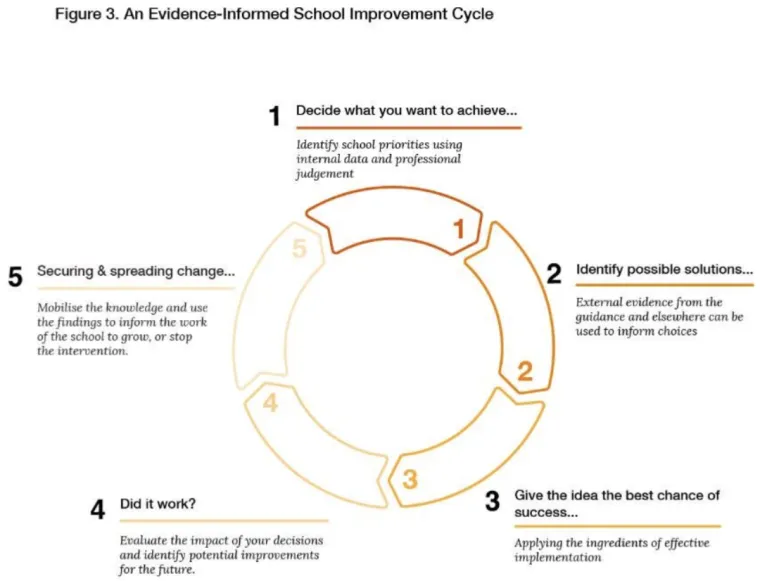
This diagram shows the evidence informed improvement cycle. It gives 5 key steps within the process.
Step 1 - identify the issue you want to tackle and the outcome you want to achieve. It is important not to jump to the solution! It is easy to underestimate how difficult some practitioners find this step. It can be really challenging to be specific or precise about issues. Take time over this step and be analytical about data - what does it tell you?
Step 2 - Think about a range of possible solutions. This is where it is best to use evidence-based research. Look at what other settings have used and it has been tried and tested. Trusted sources such as the Evidence Store or the EEF Early Years toolkit are also useful to use at this stage.
Step 3 - Try to give the things the best chance of success. Please remember how your do things is as important as what you do. Good implementation is difficult but these is growing evidence on how to do it well.
Step 4 - try to evaluate whether this has really worked for you. Has it had the impact on the children you had hoped for? This is an opportunity to prioritise effectively and stop doing things that are not effective.
Step 5 - how to sustain this change and what to do next. What will you do to spread the learning and practice across the setting?
Key Points:
View implementation as a process not an event
Implementation needs time, especially for the preparation
Have a clear, logical and well-specified plan
Know where to be 'tight' and where to be 'loose' (faithful adoption vs intelligent adaptation)
Adopt a range of implementation strategies - use high-quality training AND follow-on support
Expect things to be difficult initially - continuous improvement
Think about sustainability from the outset.
High quality professional development is key to this process.
The EEF have produced the Guide to Effective Professional Development (PD) in the Early Years.
The evidence has suggested that having a balanced approach is essential for successful PD for practitioners.
Within this balanced approach are 4 key areas;
- Build knowledge
- Motivate educators
- Develop teaching techniques
- Embed Practice

Within this evidence review the EEF found there were 14 mechanisms within these 4 areas that when used could make PD more effective. These mechanisms have been shown to lead to change in practice.
This guidance has identified 5 mechanisms which work well within the EY Sector

A; Build Knowledge
Mechanism 1 - Carefully manage how much knowledge and information practitioners have to process. It is important to present new information in ways that support understanding. It is important to avoid cognitive overload.
B; Motivate Educators
Mechanism 2 - Always present information from a credible source. Sources that information is gained from directly impacts how motivated practitioners are to use it. This links closely to the need for PD to be based on research based evidence.
C; Develop Teaching Techniques
Mechanism 3 - Arranging practical social support is vital, peer support can encourage and facilitate development. Peers can often provide emotional or informational support to colleagues looking to improve practice.
D; Embed Practice
Mechanism 4 - Once practitioners have built their knowledge base it is useful for PD leads to provide prompts ad cues to help provide a reminder on when to use the approaches in practice. This could be as simples as modelling the approach or verbal praise when they see a practitioner using the approach in a child/adult interaction.
Mechanism 5 - Write an action plan to prompt future implementation. This could be as simple as 'by next week we will all have...' Build a realistic time line and always remember things take longer than you first think!