
In this 3 minute read, find out about what ‘really works’ to improve practice in Early Years settings and how you and your setting can take part in professional development with real impact for children and families.
A quality learning experience for children requires a quality workforce. A well-qualified, skilled staff strongly increases the potential of any individual setting to deliver the best possible outcomes for children”
DfE (2021), ‘Statutory Framework for the Early Years Foundation Stage’ (3.21, p.26).
Ensuring a high-quality workforce means having access to high-quality Continuing Professional Development (CPD). Most of us have had the opportunity to engage in a range of professional development opportunities or training; some of which we may define as high-quality, others not so much!
Some ‘courses’ have been more memorable than others, some have given us new ideas and inspirations, some have provided us with the essential knowledge needed to fulfill the statutory requirements of our role (yawn) and most, the opportunity to meet likeminded professionals with whom we can share stories and have a moan (despite loving our jobs really!).
But how many of these opportunities have led to long term change in the way we educate and care for our children? How much of this newly acquired knowledge is embedded and remains integral to improving outcomes for our children year on year?
There isn’t a magic formula that ensures the quality and positive impact of all professional development opportunities, but fortunately we now know, though the experiences of ourselves and others, what are likely to be our best bets.
Research states that there are a range of factors that are likely to make CPD more effective, instigating change which is sustainable, developing practice (acquiring and retaining knowledge and technique) and ultimately improving outcomes for children and families.
These factors include:
- Having a specific objective, knowing what you want to achieve, right from the start.
- Opportunities for active involvement from all participants
- Using evidenced based principles – things that have already been proven to work
- A specific focus on practice with planned opportunities to try out what has been learned, with children
- Collective participation – learning with peers who have similar experiences and development needs
- Longer programmes that tend to be more effective than one off sessions
- Expert input and ongoing support
- Motivation and inspiration
Professional development opportunities designed around these elements are more likely to be effective. However, in order to ensure that the first thing on the list, a specific objective, is integral to your thinking when planning CPD opportunities, it is essential to first of all consider the specific needs of your setting.
Professional development or staff training needs to be included as part of your Whole Setting Development Plan. Ideally, the whole team needs to be involved in developing this plan, giving everyone ownership and most importantly an understanding of what you are trying to achieve together.
Evidence states that the ‘less is more’ approach works best, when deciding on your focus for whole setting development, as well as the development of your staff team. Whilst it may be tempting (especially now when there is so much on offer) to grab hold of every opportunity, this approach is known not to be effective. Too much input from a range of sources can be overwhelming and confusing and knowledge is less likely to stick. Focus on just a few elements for improvement.
Based on the needs of the children and families, create your Whole Setting Plan, evaluate the professional development needs of the staff team and only then, carefully select opportunities that meet those needs best. There needs to be a plan in place for longer term development, based on those few key objectives, matched to professional development need, rather than staff just picking something that they fancy!
Ideally, more than one person from a setting (or similar setting in the case of childminders) should participate in professional development, as evidence states that together they are far more likely to gain a better understanding, learn more and successfully share their learning with others.
This could enable the whole team to benefit and ultimately there will be a much higher likelihood of the change in practice you were hoping for to occur. Where as the thought of releasing one person, let alone two in these massively challenging times (we are ALL struggling with staffing and recruitment) may seem impossible, forward planning usually helps and the long-term benefits will be worth it and much more likely to have the desired impact.
Success in embedding change takes time! Plan for learning to be ongoing in smaller chunks, interspersed with planned opportunities to put theory and new skills and techniques into practice, in your setting with your children. Expect there to be some barriers and work together to overcome them rather than getting disheartened.
Leaders will need to enable and empower staff, providing support where necessary and encouragement to carry on, reminding the whole team of the importance of what you are trying to achieve together.
The Education Endowment Foundation have put together a guide to ‘Effective Professional Development in the Early Years’ support for those choosing, developing or planning high quality professional development opportunities for early years professionals.
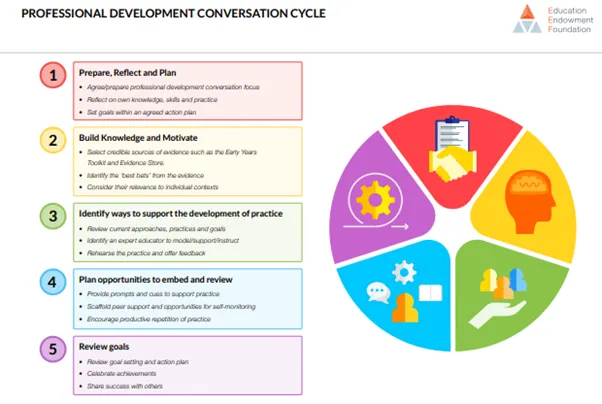
It includes all the evidence-based ‘mechanisms’ that ideally need to be included in effective CPD. It is specifically for the Early Years sector which is welcomed and is laid out in an accessible, usable way – definitely work a look. This first edition has been put together to support the DfE’s Early Years Education Recovery Programme ‘Stronger Practice Hubs’ and if the idea of putting together your own high-quality professional development opportunities seems daunting or a little out of reach, this is where we come in!
St Edmund’s Early Years Stronger Practice Hub has designed a range of ‘Specialist Learning Networks’ which are offering opportunities to Early Years Professionals to come together to share knowledge and effective practice. Our ‘Development Needs Analysis’ established that you wanted input from peers and experts in the following areas:
- SEND
- Communication and Language
- Outdoor Play and Learning
- Pedagogical Leadership
The Networks provide the opportunity to meet other professionals with a shared interest in a specific area of learning, build professional relationships and participate in professional discussions, gain access to valuable resources, share ideas and learn about the latest trends and CPD opportunities.
They are delivered in a variety of ways at a variety of times, including face to face or virtual sessions, some will have inspiring guest speakers, others will have focused discussions.
The Networks will be designed around the needs and interests of participants. Expert practitioners will inspire, advise and motivate and will be available to answer questions and offer support throughout. You will be expected to engage with the network over a number of sessions and months and be motivated to take what you have learned, put it into practice in your setting, share your successes and challenges and make a real difference to your children.
If these areas fit in with the development needs of yourself, your colleagues and your setting, visit our website to book a place.
If you have any questions about Effective Professional Development in the Early Years or the Early Years Stronger Practice Hubs, please contact us at: [email protected]
The motivation to continually refine ones’ practice is part of what it means to be an early years professional.
As Dylan Wiliam says:
“all practitioners need to improve not because they are not good enough, but because they can be even better”
References
Guide to Effective Professional Development in the Early Years – Education Endowment Foundation April 2023
Professional Development Conversation Cycle - Education Endowment Foundation May 2023
Statutory Framework for the Early Years Foundation Stage – DfE 2021
What is CPD? Early Years Educator - Aaron Bradbury Jan 2022
The Power of Professional Learning - Early Education Journal Spring 2020
Nursery Management Training, the right mix – Nursery World March 2019
Zaslow et al(2010) Towards the Identification of Features of Effective Professional Development for Early Childhood Educators: Literature Review
Stoll et al(2012) Great professional development which leads to great pedagogy: nine claims from research