Communities of Practice in the Early Years
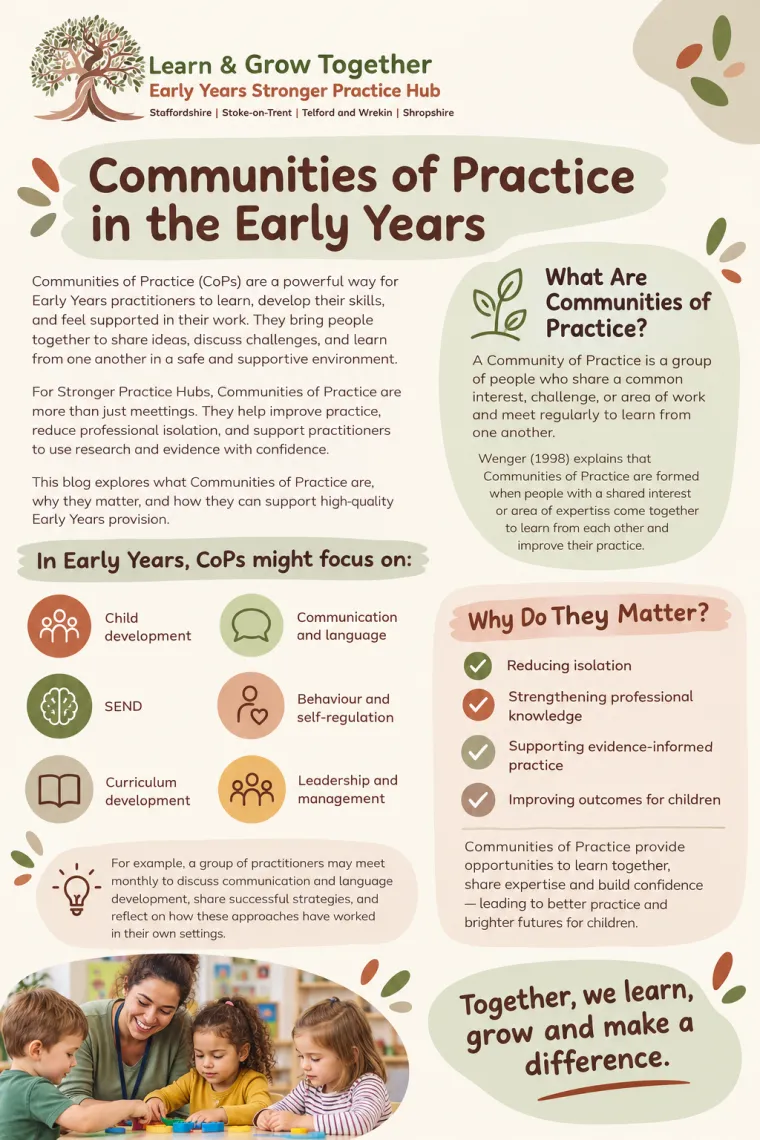
Communities of Practice (CoPs) are a powerful way for Early Years practitioners to learn, develop their skills, and feel supported in their work. They bring people together to share ideas, discuss challenges, and learn from one another in a safe and supportive environment.
For Stronger Practice Hubs, Communities of Practice are more than just meetings. They help improve practice, reduce professional isolation, and support practitioners to use research and evidence with confidence.
This blog explores what Communities of Practice are, why they matter, and how they can support high-quality Early Years provision.
What Are Communities of Practice?
A Community of Practice is a group of people who share a common interest, challenge, or area of work and meet regularly to learn from one another.
Jean Lave and Etienne Wenger developed the concept (1991). Wenger (1998) explains that Communities of Practice are formed when people with a shared interest or area of expertise regularly come together to learn from each other and improve their practice.
In Early Years settings, a Community of Practice might focus on areas such as:
- Child development
- Communication and language
- SEND
- Behaviour and self-regulation
- Curriculum development
- Leadership and management
For example, a group of practitioners may meet monthly to discuss communication and language development, share successful strategies, and reflect on how these approaches have worked in their own settings.
Why Do Communities of Practice Matter?
Early Years practice is rewarding, but it can also be challenging. Practitioners work in different settings, with different children and families, and often face complex situations.
Communities of Practice provide opportunities to learn together and support one another.
Reducing Isolation
Some practitioners work in small teams or independently, particularly childminders. Communities of Practice help people feel connected to a wider professional network. Nutbrown (2012) highlights the importance of professional relationships, suggesting that practitioners learn most effectively when they feel supported and connected to others within the sector.
Strengthening Professional Knowledge
Discussing practice with colleagues helps practitioners reflect on what they do and why they do it. Grenier (2021) argues that collaborative professional learning helps practitioners develop shared understanding, leading to more consistent and reflective practice.
Supporting Evidence-Informed Practice
Communities of Practice provide opportunities to explore research and think about how evidence can be applied in real-life settings. According to the Education Endowment Foundation (2021), professional development is most effective when it takes place over time, involves collaboration with others, and is informed by evidence and research. Golinkoff and Hirsh-Pasek (2017) emphasise that children benefit when practitioners use research and evidence to inform their decisions about learning and development.
Improving Outcomes for Children
The ultimate goal of professional development is to improve outcomes for children.
When practitioners share knowledge, reflect on research, and develop their practice together, children benefit from more effective teaching, stronger interactions, and better learning experiences.
What Happens in a Community of Practice?
According to Wenger (1998), successful Communities of Practice have three key elements:
A Shared Focus
Members come together because they are interested in the same topic or area of practice.
A Supportive Community
Practitioners build relationships, share experiences and support one another's learning.
Shared Practice
Members develop resources, strategies and approaches that can be applied in their own settings.
Activities within a Community of Practice might include:
- Discussing real challenges from practice
- Sharing examples of successful approaches
- Exploring research together
- Trying out new ideas and reflecting on the results
- Visiting other settings
- Creating shared resources
This ongoing cycle of learning, trying new approaches and reflecting on outcomes helps practitioners improve their practice over time.
The Role of Stronger Practice Hubs
Stronger Practice Hubs are well placed to support and facilitate Communities of Practice across the Early Years sector.
They can provide:
Expert Facilitation
Facilitators help guide discussions and connect research with everyday practice.
Access to Specialist Knowledge
Practitioners may learn from speech and language specialists, SEND professionals, curriculum experts, researchers and experienced leaders.
Opportunities for Reflection
Communities of Practice encourage practitioners to try new approaches, review their impact and make improvements where needed.
A Safe Learning Environment
Practitioners need to feel comfortable discussing challenges, asking questions and sharing experiences. Stronger Practice Hubs help create this supportive culture.
Sector-Wide Improvement
By bringing practitioners together, Communities of Practice can help promote consistent, high-quality practice across different settings.
What Makes a Community of Practice Successful?
Research suggests that successful Communities of Practice share several important features:
- Regular meetings and ongoing participation
- Shared ownership and responsibility
- A focus on evidence-informed discussion
- Links to real, everyday practice
- Trust, respect and openness among members
It is also important that practitioners feel their voices are valued and that discussions are relevant to the challenges they face.
Challenges to Consider
Although Communities of Practice offer many benefits, they are not without challenges.
Finding time to meet regularly can be difficult in busy Early Years settings. Some practitioners may feel nervous about sharing their experiences, while others may find it difficult to engage consistently.
Without effective facilitation, discussions can drift away from evidence and become focused solely on personal opinion.
This is why strong leadership, clear goals and a supportive culture are important for success.
The Impact of Communities of Practice
When Communities of Practice are well supported, they can lead to:
- Increased practitioner confidence
- Stronger professional relationships
- Greater use of evidence-informed approaches
- More consistent practice across settings
- Improved curriculum development
- Better outcomes for children
For these reasons, Communities of Practice continue to play an important role in the work of Stronger Practice Hubs and in supporting a skilled, reflective and connected Early Years workforce.
Conclusion
Communities of Practice provide valuable opportunities for Early Years practitioners to learn with and from one another. By sharing experiences, engaging with research and reflecting on practice together, practitioners can build their knowledge, confidence and professional skills.
For Stronger Practice Hubs, Communities of Practice are an effective way to support continuous improvement and help ensure that children receive high-quality early education and care.
Reference List (Harvard Style)
- Bruce, T. (2015) Early Childhood Education. 4th edn. London: Hodder Education.
- Clark, A. (2011) Listening to Young Children: The Mosaic Approach. 2nd edn. London: National Children’s Bureau.
- DfE (2024) Early Years Foundation Stage Statutory Framework. London: Department for Education.
- Education Endowment Foundation (EEF) (2018) Putting Evidence to Work: A School’s Guide to Implementation. London: EEF.
- Education Endowment Foundation (EEF) (2021) Effective Professional Development. London: EEF.
- Education Endowment Foundation (EEF) (2024) Early Years Toolkit. London: EEF.
- Golinkoff, R. and Hirsh‑Pasek, K. (2017) Becoming Brilliant. Washington, DC: American Psychological Association.
- Grenier, J. (2021) Principles into Practice. London: Department for Education.
- Lave, J. and Wenger, E. (1991) Situated Learning. Cambridge: Cambridge University Press.
- Nutbrown, C. (2012) Nurturing Babies and Toddlers. London: Sage. Ofsted (2022)
- Best Start in Life: A Research Review for Early Years. Manchester: Ofsted.
- Wenger, E. (1998) Communities of Practice. Cambridge: Cambridge University Press.