
Lesley Harris reflects on the magic of child-led learning and the power of intentional adult interactions in early years settings.
Through a simple moment of curiosity, a child’s loose tooth, educators at Weoley Castle Nursery School unlock a rich, generational conversation that blossoms into a shared inquiry about oral health, family stories, and the tooth fairy.
This blog celebrates how skilled observation, nurturing relationships, and a well-structured environment allow educators to transform everyday moments into meaningful curriculum. Drawing on High Scope principles and research from Harvard and the Education Endowment Foundation (EEF), Lesley shows how “just like that,” deep learning begins... when we’re ready to hear it!
Just a moment!
A child makes a comment that, if realised, can initiate a powerful world of learning opportunities based on existing knowledge.
The skilled adult observer captures it and seizes the opportunity to facilitate new learning.
In that moment, a deep and meaningful learning opportunity arises and provides us with the irresistible connection – children’s interests at the heart of the curriculum!

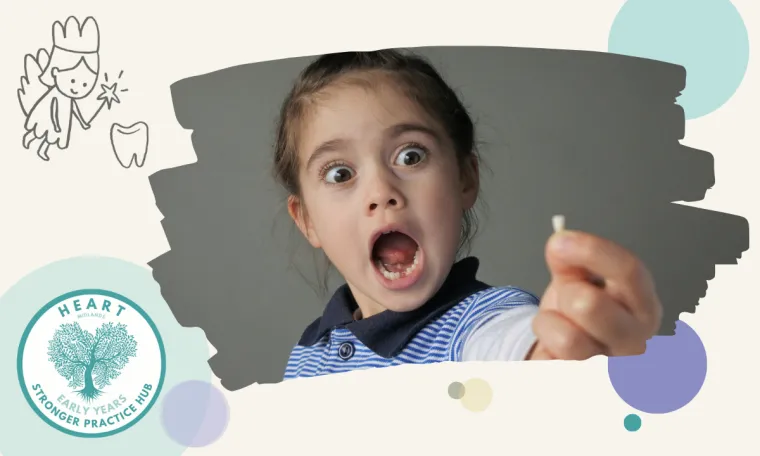
Carly is playing in the home corner. It’s work time during our plan-do-review, and she shares with Deb, her Key Adult, that her tooth is loose.
“Oh no… what’s happened?” says Deb.
“It’s ok, the Tooth Fairy will put money under my pillow when it falls out”, Carly reassures Deb, who looks puzzled and asks, “How do you know that?”
Carly explains that Dad’s told her.
Deb asks, “Do you know anyone else who has lost their tooth?”
Carly thinks and then says, “Well, it’s happened to my Nan… she’s got... falling out teeth”.
Deb is puzzled again, “Nan has falling out teeth?”
Carly nods, “but the fairy didn’t take them... she can put them back in again when she wants to.”
Just like that!
And just like that, we open up a world of knowledge and curiosity about teeth. What a gift for learning!
Links to oral health are perfect. Our responsibilities to welfare requirements are given a huge boost from a child’s perspective, as in the Early Years Foundation Stage (EYFS), promoting good oral health is a crucial aspect of a child's overall well-being and development.
All the children hear Carly’s news at recall time. Generational, personalised and from an immediate circumstance happening directly to Carly. Of course, inevitably, many of her group have news to share about this, too. And off we go!

Deb models writing Carly’s news on the whiteboard and gathers additional information from other children in the group. She discovers what they know and asks them what else they would like to know.
And so, a ‘finding out plan’ emerges - why don't babies have teeth? And what does the Tooth Fairy do with them when she takes them?
At Weoley Castle Nursery School, our educators persistently seek opportunities to identify and build on children’s interests, curiosities and fascinations to facilitate learning and development.
It may seem that it’s all just a matter of being in the right place at the right time, but that's not left to chance.
A well-structured daily routine that provides opportunities for shared play and engagement in a well-resourced learning environment will empower all adults to use observational and anecdotal assessment to enable this type of child-initiated, interest-focused shared learning.
Key research points that relate directly to this style of learning are noted in this working paper, Young Children Develop in an Environment of Relationships, from the Centre for the Developing Child at Harvard (2004):
“Young children experience their world as an environment of relationships, and these relationships affect virtually all aspects of their development.” (Page 1)
In our High Scope Nurture School, we believe that when adults show genuine interest in a child's passions and offer support and encouragement, it fosters a love of learning and a sense of self-confidence.
Research evidence tells us that developing these high-quality interactions to enable ‘shared attention’ and ‘sustained shared thinking’ is crucial to every aspect of practice in the early years and a guiding principle for effective professional development.
These are well-evidenced strategies that allow educators to demonstrate genuine interest in a child’s passions.
You can find out more about this in EEF’s Improving early education through high-quality interactions.
Ultimately, by listening closely to children and following their lead, we create a curriculum that is not only deeply engaging but truly meaningful.
Every conversation holds the potential for discovery; we just need to be ready to hear it!
--
Blog author: Lesley Harris, HEART Midlands Stronger Practice Hub
Lesley is a partner at HEART Midlands Stronger Practice Hub, Head Teacher of Weoley Castle Nursery School in South Birmingham and an endorsed trainer for High Scope and the Principles of Nurture.