

Welcome to our November 23 blog on ‘A Sensory Diet’ written and referenced by our Area SENDCo Donna Watson. Donna comes with experience of working in a special school and has extensive experience with supporting children with additional needs.
It feels like the number of children with sensory difficulties is on the rise. I do not know if this is true, but it certainly feels that way when talking to practitioners and visiting settings.
Meeting the sensory needs of children seems to be an area that practitioners feel a little out of their depth in and understandably so. Sensory difficulties can manifest in many ways, and it is not always easy to recognise that a particular behaviour, is due to a sensory difficulty.
Sometimes it is obvious a child has sensory needs. They may demonstrate them by biting, chewing, touching, rubbing, hiding when it’s too noisy or covering their ears. They may be drawn to the lights and the calmness of the sensory room or shy away from touch and cuddles. They may only eat certain texture foods.
In these cases, helping a child with their sensory needs seems straight forward. Provide a calm, quiet place. Provide ear defenders. Allow the child more time outside. Be sensitive to touch. Be patient and supportive with food etc. However, there is a phrase that I was introduced to many years ago by a wonderful occupational therapist, whilst working with the most complex children, you may have heard of it, ‘a sensory diet.’

What is a sensory diet?
It is an individualised plan created to meet the sensory needs of the child.
An occupational therapist would undertake a sensory profile assessment to ensure that the activities recommended are the most appropriate for that individual.
‘The main goal of a sensory diet is to prevent sensory and emotional overload by meeting the nervous system’s sensory needs; however, it can also be used as a recovery technique. Understanding a child’s sensory profile and the activities which create calmness and regulation can really help when a child feels overwhelmed and out of control. Engaging children in sensory experiences on a regular schedule can support focus, attentiveness, and interaction. Children may feel less anxious when they feel comfortable and in control.’ (Autisimawareness.com)
What can we do in our settings to support these needs when we don’t have access to an occupational therapist?
There are activities that you can build into a child’s day to help them meet those sensory needs. These activities not only benefit those with sensory needs, but they would have a positive impact on all children and so these activities do not need to be done on a 1:1 basis. It is important to note that a sensory diet, implies that a range of these activities are available in regular periods throughout the day. For those children who really struggle to keep calm and regulated, it is not enough to provide only one of these activities each day.
They should have regular access to a range that are suitable for them. Children will naturally be drawn to activities that are meeting their needs, so observe. Provide more types of activities and opportunities in the day for these activities to take place. By taking part in a sensory diet throughout the day, you are helping the child meet their sensory needs and helping to keep them calm which will ultimately support them with their learning.
Below is a list taken from the autismawareness.com website. This website is amazing for increasing your understanding, giving ideas and checklists so you know what to look out for.
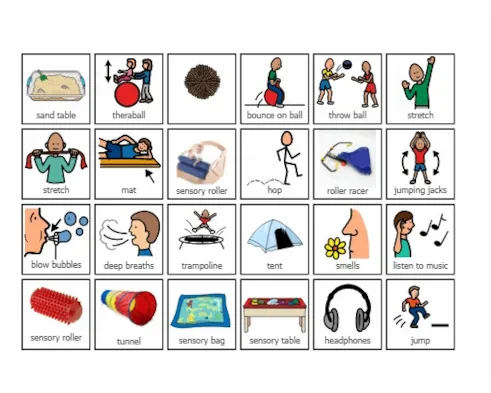
Proprioception
Proprioceptive input can be achieved through lifting, pushing, and pulling heavy objects. Some ideas are:
- pushing a stroller or cart
- pulling a wagon filled with objects
- carrying a backpack
- playing hopscotch
- push ups against the wall
Vestibular
Vestibular input (sense of movement) is created by any type of movement such as spinning or swinging. Some ideas are:
- swinging on a swing
- lying in a hammock
- spinning on a Sit n’ Spin or disc
- rolling
- jumping jacks
- dancing
Tactile
The tactile sense detects light touch, deep pressure, texture, temperature, vibration, and pain. Some ideas are:
- drawing in sand or salt
- hand massage
- high fives
- play with therapy putty, squeeze balls, a band to pull on.
- crocheting, knitting, or sewing.
- messy play with shaving cream or foamy soap
Auditory
Auditory input is what we hear and how we listen. Some ideas for calming and organizing auditory input are:
- listening to music
- listening to sounds in nature
- use noise cancelling headphones to dampen sound.
- playing a musical instrument
- listening to running water
Smell
Smelling certain odours can stimulate, calm, or send a person into sensory overload. When it comes to smells, think about:
- exploring calming scents to find preference. Lavender, vanilla, jasmine and rose are examples of calming scents.
- exploring alerting scents like peppermint or citrus
- sniffing different herbs and spices
Taste
Taste input is perceived by the tongue but how it’s interpreted or experienced is strongly influenced by the sense of smell. When it comes to taste, experiment with different flavours. Oral sensory processing not only involves taste, but tactile and proprioception too.
- Strong tastes can stimulate the under sensitive child.
- Involve children in food preparation to increase their likelihood of trying new foods.
- Offer crunchy foods such as raw veggies, popcorn, pretzels, apples for those who like to chew.
- For the child who likes to chew, use chewy jewellery.
- Other ideas for chewy foods are fruit leather, beef jerky, marshmallows, or raisins.
- For children who like to suck or lick things, try popsicles, ice cubes, or drinking through a straw.
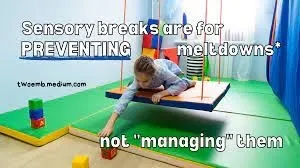
There are many more ideas out there. Google images sensory diet to see more.
I will leave you with this thought...
Other good websites to check out:
https://www.theottoolbox.com/how-to-create-sensory-diet/
https://nogginsland.com/2022/07/13/what-is-a-sensory-diet/
For more support or advice please feel free to contact us at the Hub.