
1. Introduction
Language development in early childhood is not an isolated milestone; it is the fundamental vehicle through which young children communicate, form relationships, regulate emotions, and understand their world. Children learn and develop more from birth to five years old than at any other point in their lives. Because the brain undergoes extraordinary neural growth during this formative window, the experiences provided from birth to age four represent the single most important opportunity to establish receptive and expressive communication.
Crucially, high-quality early years education with a strong focus on communication is vital for every child, but it is especially positive for children from disadvantaged backgrounds. National evidence indicates that when children start school, those from disadvantaged backgrounds are, on average, 4 months behind their peers in their development. Without deliberate, responsive support, language disparities do not resolve over time; instead, early learning gaps identified by the end of the early years will, on average, double by the end of primary schooling.
In early years settings, communication cannot be treated as an intermittent intervention or confined to designated circle times. The core objective of this blog post is to demonstrate how practitioners can build a continuous, language-rich environment that actively closes developmental gaps. By pairing thoughtfully planned physical spaces with intentional adult scaffolding, early educators ensure that all children, especially those at risk of falling behind receive the rich communicative experiences they need to catch up, keep up, and thrive.
2. What does the evidence say?
Grounding early childhood pedagogy in statutory policy and robust research clarifies why communicative competence serves as the foundation for all subsequent learning. The statutory educational programme within the Early Years Foundation Stage (EYFS) statutory framework establishes spoken language as the bedrock across all areas:
“The development of children’s spoken language underpins all seven areas of learning and development. Children’s back-and-forth interactions from an early age form the foundations for language and cognitive development. The number and quality of the conversations they have with adults and peers throughout the day in a language-rich environment is crucial. By commenting on what children are interested in or doing, and echoing back what they say with new vocabulary added, practitioners will build children’s language effectively.”
— Statutory Framework for the Early Years Foundation Stage (EYFS)
Complementing the statutory framework, the non-statutory curriculum guidance, Development Matters, published by the Department for Education (DfE), identifies 'The best for every child' as a foundational feature of effective practice. It emphasises four core principles for educational equity:
- Equal Chance of Success: All children deserve an equal chance of success. Children who have lived through difficult circumstances begin to grow stronger when they encounter stable, high-quality care and education.
- Immediate Support Beats Waiting: When children are at earlier stages of development than expected, it is not helpful to wait for them to become 'ready'. Waiting allows developmental gaps to widen. Children who are not yet speaking in sentences will not be able to write in sentences; they require immediate, rich conversational experiences.
- Proactive SEND Identification: Inclusive early years practice demands that Special Educational Needs and Disabilities (SEND) and speech delays are identified promptly so targeted support can be provided without delay.
- Repurposing Workload: By reducing excessive paperwork and tracking data, practitioners free up vital time. This time must be redirected toward listening to children and having extended conversations with those who are struggling.
To translate statutory mandates into practical delivery, the Education Endowment Foundation (EEF) Early Years Evidence Store synthesises research across early childhood settings, including childminders, day nurseries, and nursery schools. The EEF highlights Communication and Language as a core developmental theme. Their research demonstrates that the most impactful approaches focus on high-quality everyday interactions, dialogic reading and responsive conversational turns rather than isolated grammar drills. Furthermore, because children from disadvantaged homes may experience fewer language-rich exchanges, settings must foster strong, respectful parental partnerships that equip families to chat, play and share stories at home.
3. Example in Practice
An enabling language environment pairs intentional physical spaces with responsive, sensitive adult scaffolding. Rather than testing children with rapid-fire, closed questions, practitioners act as conversational partners who comment, listen patiently, model rich vocabulary and provide adequate thinking time.
Responsive Interaction & Questioning Techniques in Daily Provision:
- Narration and Commentary: “I see you looking at the water… splash! It feels cool on your fingers.” Follow the child's focus of attention and provide words for their sensory discoveries.
- Open-Ended Inquiry: “You found a big truck. Where is it travelling to today?” Invite the child to formulate ideas rather than offering simple yes/no answers.
- Recasting and Expanding: Child: “Doggy run!” → Adult: “Yes, Jenna, the fluffy brown dog is running so fast across the grass!” Affirm their meaning while naturally modelling correct grammar and descriptive adjectives.
- Speculative Thinking: “I wonder what might happen next if we turn the wheel?” Prompt sustained shared thinking, encouraging children to predict, reason, and solve problems jointly.
- The 4-to-1 Interaction Ratio: Strive for four genuine comments or observations to every one question. This creates a relaxed conversational flow and prevents children from feeling interrogated.
- Generous Processing Time: Provide at least 10 seconds of processing time before prompting again. Young children require processing pauses to comprehend spoken words and structure their spoken thoughts.
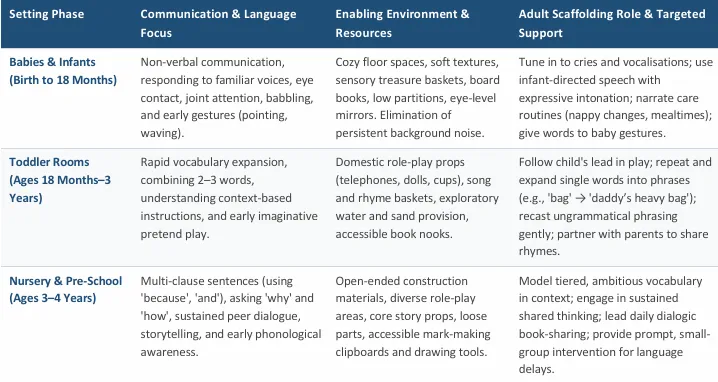
Environmental Progression Matrix (Birth to 4):
The physical environment must adapt alongside children's communicative capabilities, progressing from sensory, attachment-rich spaces to dynamic dialogic and narrative provisions:
4. Summary:
Creating an enabling language environment is simultaneously a pedagogical priority and a matter of social equity. Reflecting on evidence-based practice highlights five essential takeaways for practitioners:
- Early Intervention Closes Widening Gaps: Children from disadvantaged backgrounds start school on average 4 months behind, and early learning gaps double by the end of primary school if left unaddressed. High-quality early language environments provide the strongest protection against persistent disadvantage.
- Immediate Support Beats Waiting for 'Readiness': Children who struggle with speech or sentence formation do not benefit from waiting to mature. They need immediate, intentional, language-rich experiences with attentive adults to catch up and keep up.
- Everyday Conversations Outweigh Formal Testing: True linguistic growth occurs through sustained back and-forth interactions, sensitive narration, and unhurried conversations embedded in daily play, mealtimes, and outdoor exploration.
- Responsive Recasting Builds Communicative Agency: Repeating ungrammatical utterances accurately with added descriptive vocabulary rather than issuing direct corrections will build competence while keeping children enthusiastic about talking.
- Family Partnerships Multiply Impact: Because home learning environments vary significantly, early years settings play a vital role in supporting families to chat, play and share rhymes and stories at home.
5. References
1. Department for Education (DfE) (2024). Statutory Framework for the Early Years Foundation Stage (EYFS). London: GOV.UK.
2. Department for Education (DfE) (2023). Development Matters: Non-statutory Curriculum Guidance for the Early Years Foundation Stage. London: GOV.UK.
3. Education Endowment Foundation (EEF) (2022). Early Years Evidence Store: Communication and Language Theme. London: EEF.
4. Education Endowment Foundation (EEF) (2023). Early Years Toolkit: Communication and Language Approaches. London: EEF.
Gemma Callaghan - Headteacher