
About the Author: Katrina Di Girolami is the Early Years Lead for WISE Academies Trust. Since qualifying as a teacher in 2007, she has worked in Early Years, and currently leads a team of key educators across the Trust. Her recent work has focused on developing the Trust’s Writing Guidance, ensuring it is fully aligned with the most recent research and statutory guidance.
Writing presents a hugely complex task for our youngest learners. This series of blogs explores key messages from the DfE Writing Framework and Ofsted’s Strong Foundations in the First Year of School report, emphasising why securing early writing skills is crucial for a child's educational journey. We are committed to getting writing right at WISE Academies Trust, and throughout this series you'll find an exploration of the pivotal areas we prioritise and a list of evidence-based resources from the EEF’s Early Years Evidence Store to deepen your understanding. In Part 1 we will explore the important role of oral composition.
Oral Composition: Language as the Bedrock of Writing 💬
Ofsted states simply: “Language is the bedrock of thinking and learning. It should be a priority in the curriculum.” Before a child can write a sentence, they must be able to say it. Oral composition—the process of saying aloud what they want to write—is repeatedly emphasised as the mechanism for developing this skill.
Quality Over Quantity: Managing Cognitive Load 🧠
The DfE Writing Framework provides a critical warning: Do not push children into lengthy writing tasks too early. Instead, it advocates for a focus on quality over length.
"Pupils should be encouraged to compose orally while they are developing their transcription skills."
The guidance suggests that the majority of composition in the early years will be oral. Crucially, oral composition should be taught separately from transcription to effectively mitigate cognitive load. By delaying the physical demands of writing, we free the child's mind to focus entirely on generating high-quality ideas and structure.
WISE Academies’ Evidence-Based Progression 🔍
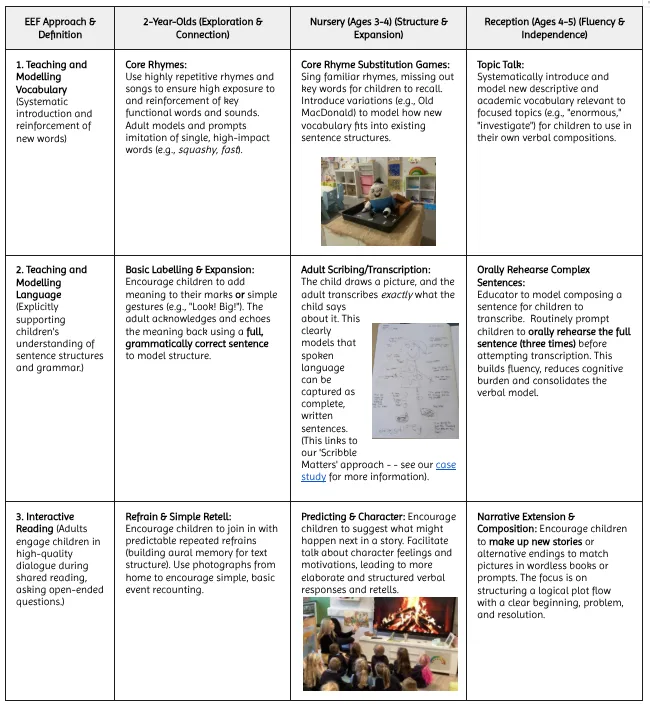
To ensure effective oral composition practice, WISE Academies provides educators with a progressional bank of activities, carefully sequenced from our 2-year-old provision through to Reception.
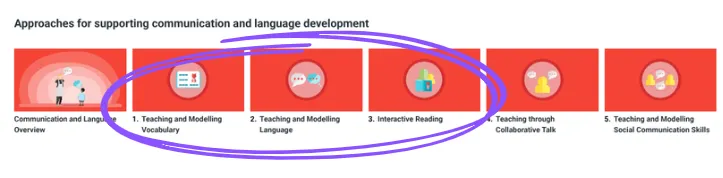
This progression is explicitly informed by the EEF Early Years Evidence Store: Communication and Language. Evidence suggests that ‘Teaching and Modelling Vocabulary,’ ‘Teaching and Modelling Language,’ and ‘Interactive Reading’ have the most positive outcomes on children’s communication and language skills, which are prerequisite for composition.
See below for an example of some of the evidence-informed activities we have implemented (please note - you can view this better if you download this blog):
Take a moment to reflect 💭 Consider your daily practice and the crucial role of oracy:
- How often do you give children the opportunity to develop their oral composition/language skills separately to writing? (e.g. time to plan and rehearse ideas without the immediate pressure of holding a pencil).
- During a dictated writing task what immediate impact would structured oral rehearsal (saying the whole sentence three times) have on reducing their cognitive frustration and errors?
This deliberate focus on fluent oral composition, alongside the development of automatic transcription (our focus in Part 2!), creates the strongest foundation for our youngest writers. We give them the tools to navigate the complex world of writing, ensuring that their creative ideas can eventually flow freely and accurately onto the page.
If you would like to explore the WISE Academies writing strategy in greater detail, please join our webinar: ‘Unlock Early Writing Success: A Practical Approach with WISE Academies’. The session takes place on Wednesday, January 14th, 3:30 pm - 5:00 pm. Further details and booking information are available here.
Further Reading List 📚
This reading list compiles the key guidance documents and foundational research models that support the explicit teaching of oral composition discussed in this blog.
- Department for Education (DfE). (2025) The Writing Framework (Non-Statutory Guidance).
- Source: The writing framework - GOV.UK
- Ofsted. (2024) Strong foundations in the first years of school.
- Education Endowment Foundation (EEF). Early Years Evidence Store: Communication and Language.
- Great North Early Years Stronger Practice Hub. (2025) Case Study: Scribble Matters – Integrating Drawing and Oral Language in Early Years
- Source: GNEYSPH Resource Section