
Daniela is a primary school teacher with an Early Years specialism.
She has taught in nursery schools, school nurseries, children centres, private nurseries, and a reception class.
Her passions are: physical development, mathematical development and making maximum use of the outdoors to support inclusive practice.
She runs a weekly stay and play whilst also supporting practice improvement across Charter Nurseries and South London settings including a huge childminding community.
Her aim is to demystify being evidence informed and support settings to build confidence in making choices that work for them in their context whilst being informed by research.

Mathematical language leads to mathematical thinking
The EEF evidence store recommends 5 approaches for supporting mathematical development. Whilst it is suggested multiple approaches should be used together, approach 5, facilitating mathematical language, underpins all other approaches.
One year I was tasked with improving mathematical outcomes in our setting so I set about gathering practitioners’ thoughts and looking through the best available research with my team. Here I will share how we managed to implement many of the recommended approaches in a way that fit in with our setting’s structures and routines. We now share the mathematical curriculum we co created to ensure mathematical language and concepts are introduced systematically.
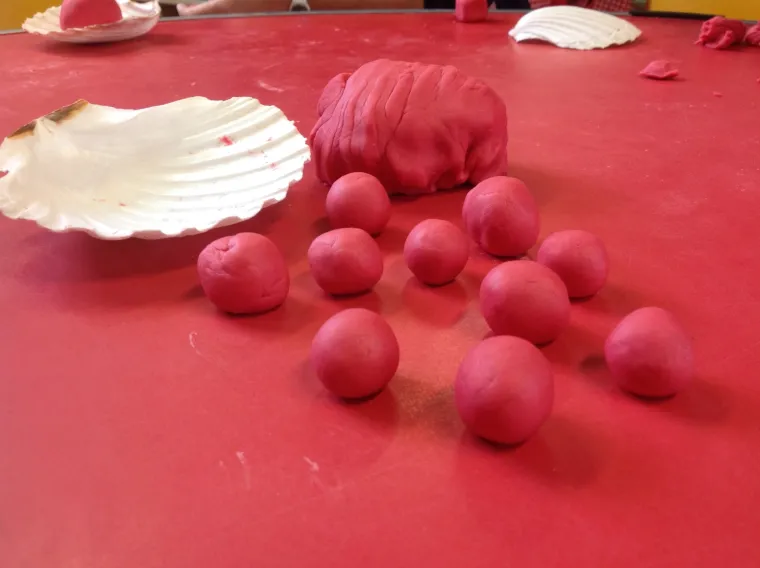
5 Approaches from the EEF Early Years Evidence Store
1. TEACHING THE ASSOCIATION BETWEEN NUMBER AND QUANTITY
2. PROMOTING FLUENCY WITH NUMBERs AND SEQUENCES
3. TEACHING PROBLEM SOLVING SKILLS FOR MATHS
4.TEACHING AND MODELLING HOW TO MAKE CONNECTIONS AND COMPARISONS
5. FACILITATING MATHEMATICAL LANGUAGE.
What do you notice?
We decided to plan for different strands of maths every half term to ensure every practitioner intentionally used vocabulary and language beyond ‘how many’ or ‘let’s count’. Mathematical language would be introduced in small group times through a hands-on open-ended game such as threading buttons onto a pipe cleaner in one minute or taking turns to fill the number line at the roll of the dice. During these groups there was a focus on all 5 of the approaches over the course of the year.
We would then provide the same introduced games in the continuous provision to offer space and time for more experimentation with ideas and opportunities to rehearse and revisit the newly introduced language such as, when throwing the five double sided beans we might say, “what do you notice?” rather than saying, “How many are red?”. This allowed the practitioner to get an insight into the child’s way of thinking and seeing amounts, “I see one there, two stuck together, one there and another one running away”, the adult might reply, “Oh yes, you can see one, one, one and two. Altogether we still have five” This language of noticing offered an opportunity to talk about the different ways of seeing amounts. If the practitioner was trying to get the child to see five objects in two groups they might then adapt the game to using two bowls in which to arrange them, “let’s see how you arrange these five beans into these two bowls. “Oh, you put all five in one bowl, so the other bowl is…………” for the child to say empty.
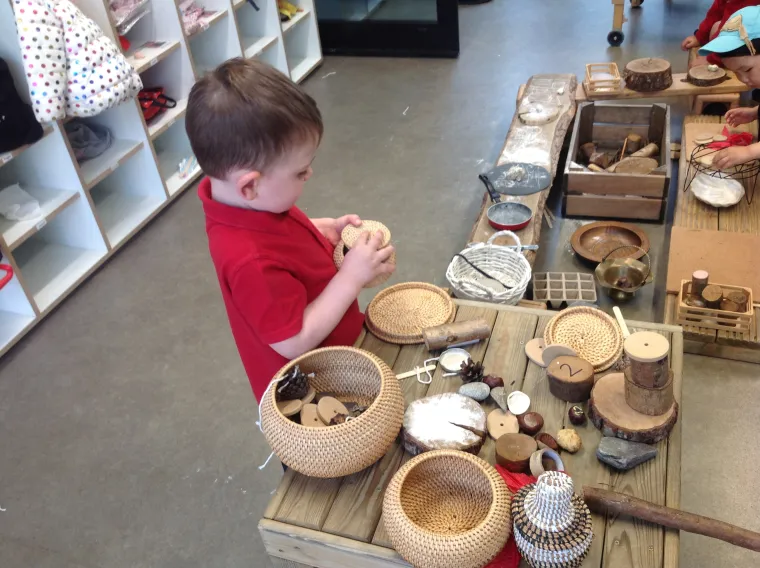
Rather than rushing for an answer we created games that offer opportunities to talk about methods, choices and how we know things. With the above example the adult wanted to reinforce the idea of conservation, the concept that an amount stays the same even though it may be arranged in different ways. The children involved also showed an awareness of seeing two groups of amounts within five.
Adapting our language became a big focus to ensure we improved our interactions and invited deep mathematical thinking. In the above example we specifically planned a series of sessions inspired by approach 4, Teaching and Modelling how to make Connections and Comparisons.
If you wish to build language and opportunities to support mathematical development consider signing up to the maths champions programme. Maths Champions is a free programme to help develop practice and support improved outcomes for children. It has a big focus on language use and precision. See the link at the end of the blog.
Opportunities to assess and target support
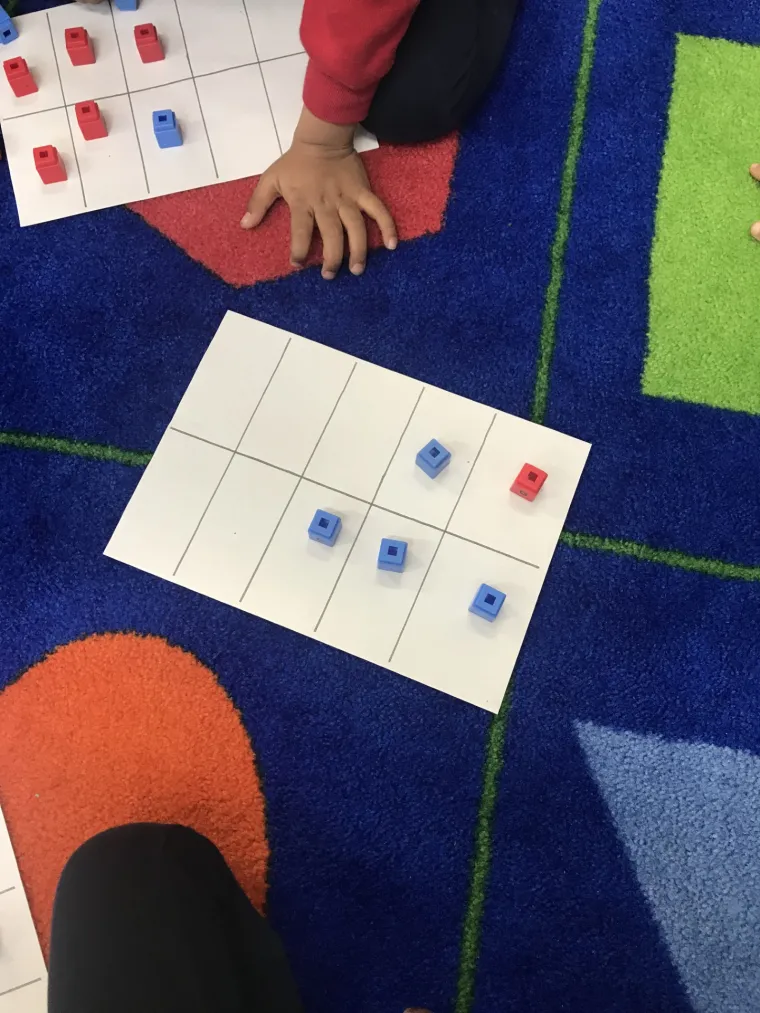
We found that working with our key children at group time allowed us to introduce games and language as well as assess understanding. This then enabled us to focus our attention on the children needing more support through child-led interactions and play. This is where the practice of scaffolding allows for development at the pace and stage of the child.
To do this well we found it useful to discuss the stages of mathematical understanding to ensure no stage was skipped or overlooked. This helped practitioners reflect and look out for developing misconceptions such as fluent reading of numerals with minimal understanding that a numeral represents an amount.
Using the above game of throwing the five two sided beans to determine amounts within amounts we would make sure we helped our children develop a ‘part-whole’ understanding over time starting with, our two-year olds playing with amounts in two bowls and adults pointing out, “we still have the same amount”. Later, sometimes at age three we’d introduce the word “total” when it was clear the child understood the concept, “Yes, the total amount does stay the same even when we arrange it in different ways” “What if we add in a third bowl? What happens then?” Research also tells us that not always do children notice the key elements necessary to learn a new skill or word so it is important adults find ways to point these out. The EEF STAIRS approach reminds us that as we climb the stairs on reaching I Important Features Need Highlighting.
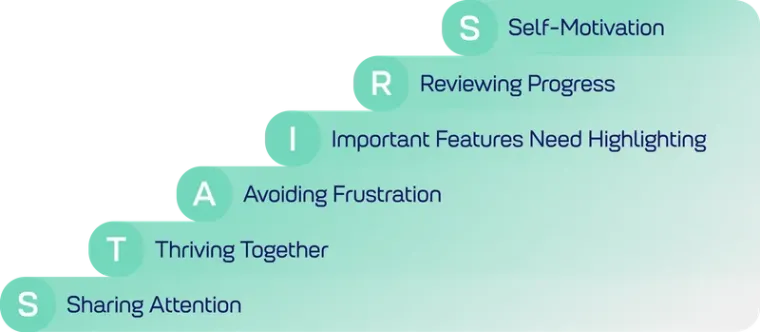
The STAIRS approach can really help practitioners refine their interactions to ensure evidence informed approaches are used to scaffold children’s learning effectively including in the area of mathematics.
Key Points
1. Ensure practitioners are confident in supporting children with their mathematical development. – consider developing a maths champion to cascade mathematical subject knowledge and evidence informed approaches across the team.
2. It really helps to build subject knowledge as a team. Use the EEF’s,
Building effective professional development for early years staff to improve practice and improve outcomes for children.
3. The recommended approaches work together with, facilitating mathematical language, underpinning all approaches. – Plan for mathematical language in a progressive way over the year using the 5 evidence informed approaches as a guide.
Useful links to learn more
For more on developing your own maths curriculum see our case study,
For more blogs on the theme of maths from the stronger practice hubs see, Maths blogs
Maths Champions Is a programme that supports practitioners to build their knowledge and practice at no cost to the setting. The programme is open to PVI, maintained nurseries and school-based nurseries.
Building effective professional development for early years… | EEF
To join the Maths Champions Programme scan the QR code below: