

Across our settings in the London South Stronger Practice Hub we asked practitioners to share their top tips for encouraging communication, especially in those with less experience of talking and the pre verbal child. Our lead childminder, lead setting, colleagues at Coin Street and the Lambeth federation of nursery schools shared the tips they use with their own staff and families. We hope you find these useful in enhancing your ability to connect with the children who are struggling most with their own communication.
- Using the child’s name to gain their attention before starting to speak to them.
- Describing & commenting what you see the child doing in their play. “You are putting the green brick on top of the blue brick.”
- Modelling a spoken response for the child of an appropriate length for them to copy but with no expectation they will repeat “banana please” when offered a choice between “Would you like banana or apple? Then following it up with a longer sentence of “Thomas chose the banana”.
- Listening for environmental sounds and asking or saying what the child can hear. “Neenor” (Emergency vehicles) and “Copter” (Helicopter) always get my children’s attention no matter what else is happening.
- Be alert that the child might understand far more than they can answer verbally and they may be very frustrated that as they don’t yet talk. This means the adult needs other ways to communicate e.g. gesturing, Makaton signing, using real objects or a visual timetable.
- Children can often remember and sing or say parts of nursery rhymes helping them to experience language before they can say sentences of 2 to 3 words.
- Signing – consistent use of a small number of Makaton signs eg finish, sit, listen, read, eat
- Use hand gestures eg pointing to support understanding
- Facial expressions – ensure the facial expression matches what is said
- Gain eye contact as far as possible whilst being aware this is uncomfortable/unnatural for some children (avoid asking verbally for eye contact)
- Give children time to respond non-verbally or verbally. Remember to pause and wait. Follow the child's gaze, deeply observe what the child is noticing. Build on that. Avoid making assumptions.
- Use generic language to support understanding eg say shoes instead of wellies, crocs, sandals, boots, etc
- Use visuals – photos or pictures eg visual timetable, now and next, - relevant to the age of children
- Use objects of reference – use an object to denote an activity. Any objects can be used, but must be consistent for children to link object to activity
Use hand over hand to communicate new skills
A reminder of the Statutory Framework statement on Communication and Language;
"The development of children’s spoken language underpins all seven areas of learning and development. Children’s back-and-forth interactions from an early age form the foundations for language and cognitive development. The number and quality of the conversations they have with adults and peers throughout the day in a language-rich environment is crucial. By commenting on what children are interested in or doing, and echoing back what they say with new vocabulary added, practitioners will build children's language effectively. Reading frequently to children, and engaging them actively in stories, non-fiction, rhymes and poems, and then providing them with extensive opportunities to use and embed new words in a range of contexts, will give children the opportunity to thrive. Through conversation, storytelling and role play, where children share their ideas with support and modelling from their teacher, and sensitive questioning that invites them to elaborate, children become comfortable using a rich range of vocabulary and language structures."
Interactions video from the DfE https://youtu.be/QHXipia3u-0
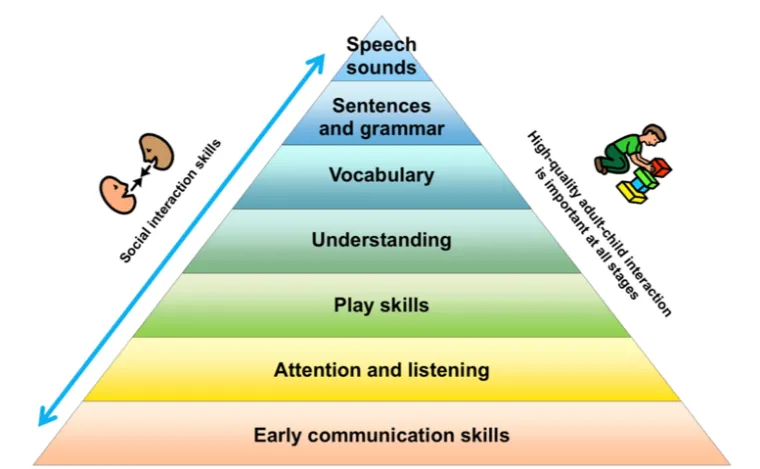
The stages of speech and language development poster,
https://speechandlanguage.org.uk/media/2162/i-can-stages-of-development-cropped-only.pdf
The OWL approach of Observe Wait (10 seconds) Listen to engage the child in conversation
more here
The Waiting Game: An Essential Skill for Parents of Children with Language Delay (hanen.org)