

Have you ever had that amazing feeling when you are on the dancefloor singing at the top of your lungs to your favourite tune? Or maybe dancing around your kitchen belting out your old time favourite, or singing in a choir or singing happy birthday to your best friend. We’ve all experienced the joy of music and how it can make us feel. And some of us may also love singing with the children in our settings. Well, it seems that there is a reason for this! And it seems this is a vital tool in our early years settings and is a practice that can be used to help children self-regulate.
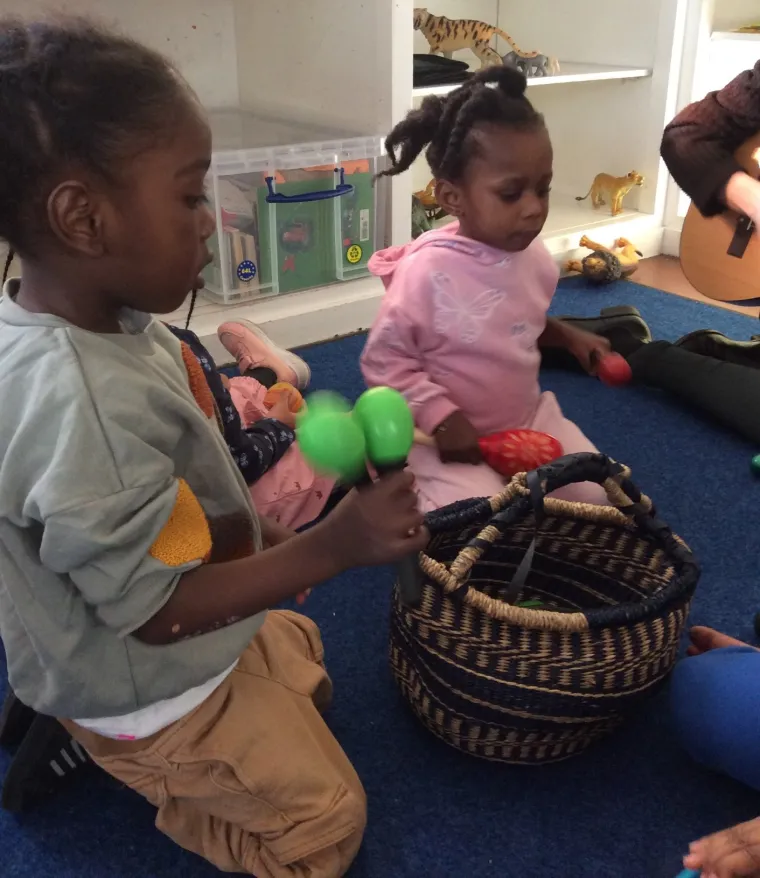
Self-regulation - i.e. impulse and behaviour control, emotional competence, and executive function (staying focussed, maintaining information and thinking flexibly)- is an important skill for children to engage in their learning. The Education Endowment Foundation (EEF) notes that it is “consistently linked with successful learning, including pre-reading skills, early mathematics and problem solving. Strategies that seek to improve learning by increasing self-regulation have an average impact of three additional months’ progress”.
Since the beginning of the pandemic we have seen more children struggling in this area as well as an increased number of children with SEND. As early years educators it's our role to assist children to develop these skills. We do this through using co-regulation strategies which can include adults modelling calming strategies and naming and talking about managing feelings and helping children focus on a task. The Birth 2 Five Matters states having a pedagogy that includes co-regulation will help children develop self-regulation skills.
So how can music be a strategy of co-regulation?
Music as a pedagogy for co-regulation
At Effra nursery we have music groups with a music therapist from Music Therapy Lambeth. They are a mixture of groups of children with SEND, small groups, family groups and whole class singing sessions.
Here are a few ways that we have seen music support children develop some of their self-regulation skills at Effra nursery.
Firstly, music is fun and is a good hook to engage children and help them stay focussed. The music sessions are facilitated by an adult and as the adult is playing an instrument too there are visual and nonverbal cues for children to help keep them focussed and engaged.
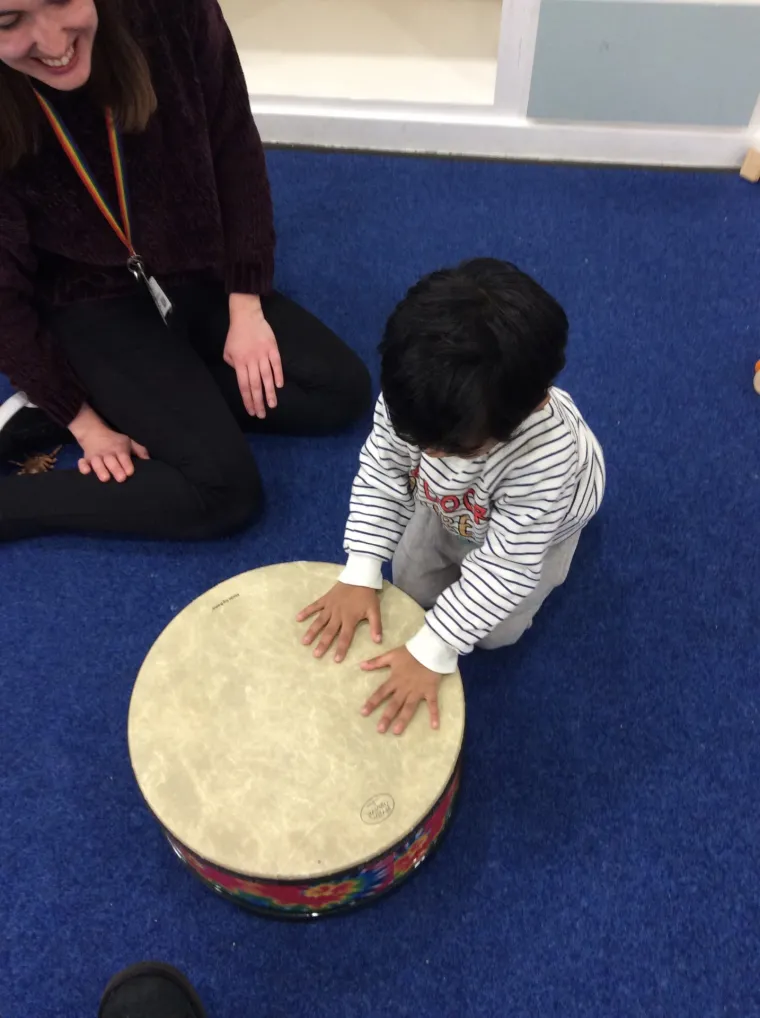
As these sessions are facilitated by an adult there is also plenty of opportunity for children to listen to and follow instructions – another important executive function skill children need to aid their learning. A favourite activity is often playing the instruments together loudly then quietly, quickly then slowly and starting and stopping. This is instructed with familiar cues such as ‘ready, steady, go!’. Anticipation is built through music and often children will giggle away when they have to abruptly stop - it's hard for the children not to have a good time! And all the while, they are tuning in and following instructions.
Another benefit children get from activities like these is practicing impulse control. Children have to wait for their turn or wait while they are handed out an instrument. If you add a song or an action to help children do this it seems to make it easier for them. Children also have many opportunities to practice sharing and playing instruments together.
In our sessions the children have the opportunity to share how they are feeling and use music to express that. Some children do not yet have the vocabulary to talk about how they feel so music is a good way of expressing and communicating non-verbally. This is guided by the music therapist who plays a song to represent that emotion and this often includes actions and body movements. She also gives the child an opportunity to talk about why they feel that way if they want to or are able to. This helps them recognise different emotions and understand how they feel in their bodies. We also finish the sessions with the ‘winding down song’ where adults offer calming squeezes on the children's arms and legs, this aims to help them physically relax and co-regulate at the end of the session. So the session always ends on a calm note.
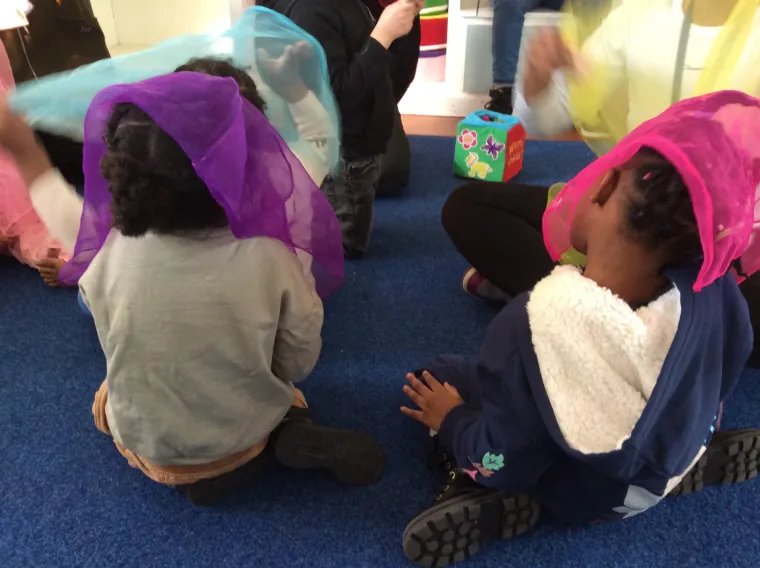
Playing music together
In our setting children regularly have a chance to come together and sing and play instruments. We have noticed that over time children who found it hard to be part of the group are able to join the larger group to join in. Many of the children show a lot of enjoyment of singing together and being part of something.
Singing and playing music is fun!! We can be loud, move our bodies and see ourselves as part of a group. This doesn’t have to just happen in small groups, this happens in the classroom, playground and plays a part in creating an enabling environment for children to self-regulate.
Music is an important element in early years education so next time you reach for the shaker, the colourful scarf or you’re sitting with a group of children reach for your inner dance floor superstar and embrace the opportunity, it could help you self-regulate too!!
https://www.musictherapylambeth.org.uk/
https://birthto5matters.org.uk/self-regulation/
https://birthto5matters.org.uk/wp-content/uploads/2021/03/EEF-self-regulation-strategies.pdf
https://early-education.org.uk/wp-content/uploads/2021/12/Musical-Development-Matters-ONLINE.pdf