

Maths, especially in the Early Years is so much more than just recognising numerals and getting the answer correct. The purpose of this blog is to look at the Education Endowment Foundation’s (EEF’s) Approaches and Practices to Support Early Mathematics.
When people talk about “Maths” the first thing that often springs to mind is numbers or numerals and sometimes even getting answers wrong and “times tables” which still gives me shivers and not in a good way! In recent years vocabulary has been introduced into Early Years Mathematics which we might not be familiar with. This could add another barrier by further knocking our personal confidence and may even perpetuate personal thoughts of “Maths is hard”. As practitioners, whatever our previous personal experiences of Maths, we need to ensure that we are positive and enthusiastic when engaging in Mathematical opportunities with children.
The EEF’s Maths Developmental Progression Spirals come from ‘Improving Mathematics in the Early Years and Key Stage 1 guidance report with a focus on children 3 to 7 years old’.
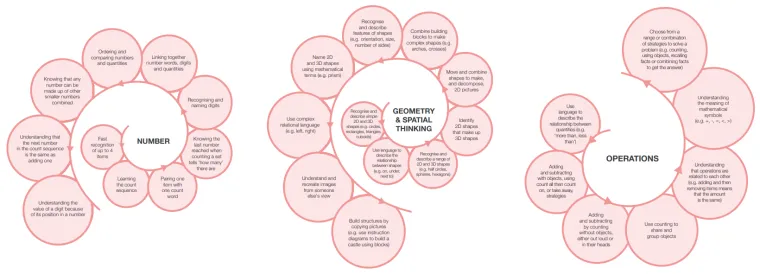
The EEF expands; “The spirals are examples of how children’s maths develops in different topics. They highlight how individual skills or concepts develop over time. While there is generally an order in which these skills may emerge, development does not take place in clearly defined linear steps. Some children may develop several skills at the same time. Other children may learn skills in different orders. This is why the diagrams are a spiral. To reach full understanding, children will need to master each of these skills. While each spiral is a separate diagram, there is considerable overlap across the topics.
Understanding how mathematical concepts typically progress can help educators understand what children need to learn next. It also helps them to build on what children already know. Then educators can expose children to a range of experiences so they can gain a full understanding of mathematical topics.”
The EEF identifies there are five Approaches that educators can use to support the mathematical development of children;
- Teaching the association between number and quantity
supporting children to develop their familiarity with numbers and understanding of quantity in different ways, such as counting sets, subitising, and matching number words and symbols to quantity; - Promoting fluency with numbers and sequences
using a range of techniques including song and repetition to support children’s fluency with numbers (for example, numeral recognition) and sequences (such as the count sequence); - Teaching problem solving skills for Maths
teaching and modelling problem-solving skills including effective ways to apply purposeful thinking; - Teaching and modelling how to make connections and comparisons
encouraging sorting collections into groups and promoting recognition of attributes that can also support with identifying and building patterns and sequences; - Facilitating Mathematical Language
intentionally using specific, informal, and formal mathematical vocabulary in context to develop children’s understanding of concepts (receptive) and explain their ideas (expressive).
Each of these approaches are explored in greater detail on the EEF’s Evidence Store including videos of practitioners and children evidencing the research, providing ideas and suggestions of how to implement each area into your own practice and setting.
The Early Years Foundation Stage (EYFS) Statutory Framework for Mathematics has a strong emphasis on number, but also states;
“It is important that the curriculum includes rich opportunities for children to develop their spatial reasoning skills across all areas of mathematics including shape, space and measures. It is important that children develop positive attitudes and interests in mathematics, look for patterns and relationships, spot connections, ‘have a go’, talk to adults and peers about what they notice and not be afraid to make mistakes.”
The EEF’s guidance on the fourth approach to support children’s mathematical development on ‘Teaching and modelling how to make connections and comparisons’ includes;
“Comparing sets of objects using words, identifying the odd one out in a set of objects, arranging objects in order of size, location, or position, using ordinal numbers such as ‘first’, ‘second’, and ‘third’, and activities involving block-building or weighing scales.”
An observation from my setting recently highlighted to me how Maths isn’t just about numbers as I observed a 2 year old child independently make a bridge while exploring blocks. They used 3 of the same shaped blocks and then continued stacking additional pieces on top of the bridge structure they had created before knocking it down with great delight, and then building another bridge again.
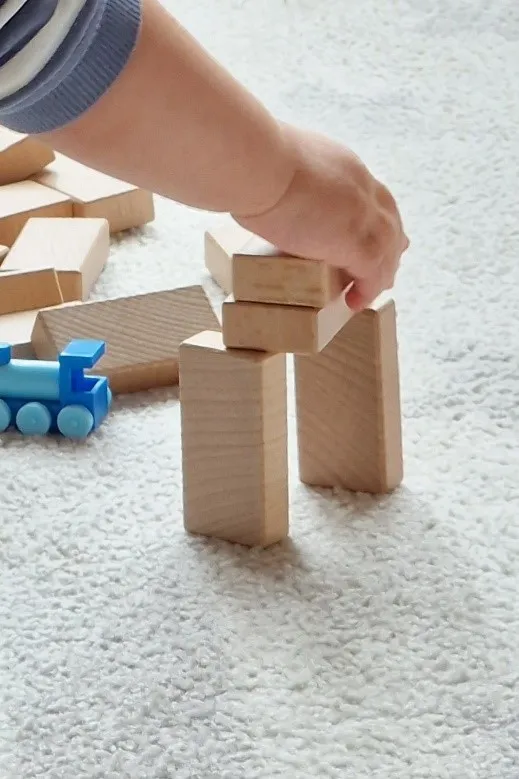
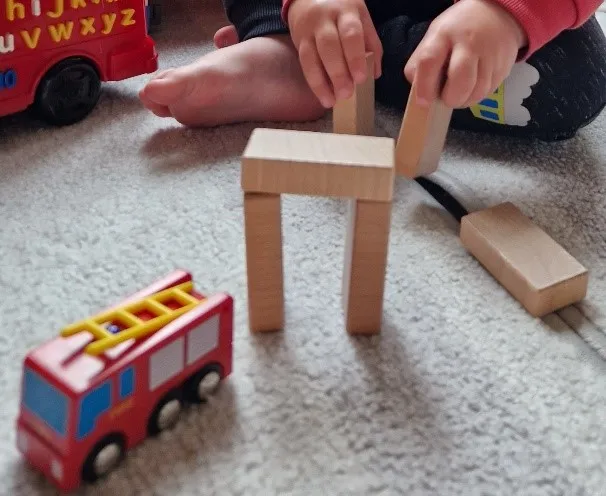
I demonstrated to another 2 year old how their friend had made a bridge and they preferred it being called “a tunnel” where they worked out which size of vehicle could fit in the gap and also take delight knocking down my example even if the vehicle could have fitted. I watched with interest as the child persevered with making the blocks stand on the carpet and working out how wide apart to place them so the block would fit across the top to make the tunnel structure.
The same 2 children, initially with adult support, worked together, taking turns to place another block to make a collaborative tower, until it naturally fell down.
Using the EEF’s developmental progression spiral for Geometry and Spatial Thinking, the children were exploring and developing their skills in ‘Combine building blocks to make complex shapes (e.g. arches, crosses)’. As a practitioner I can extend the children’s learning by ‘Use language to describe the relationship between shapes (e.g. on, under, next to)’ and ‘Recognise and describe features of shapes (e.g. orientation, size, number of sides)’.
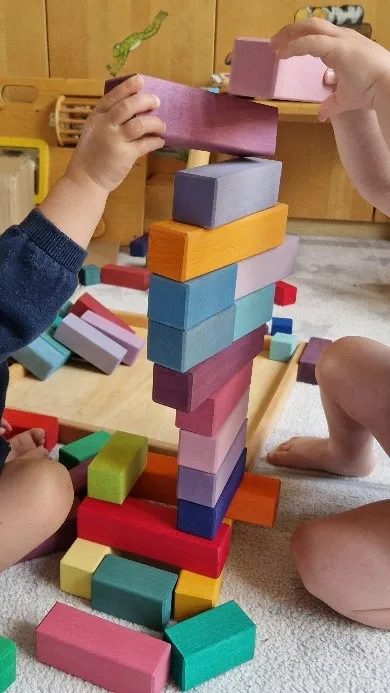
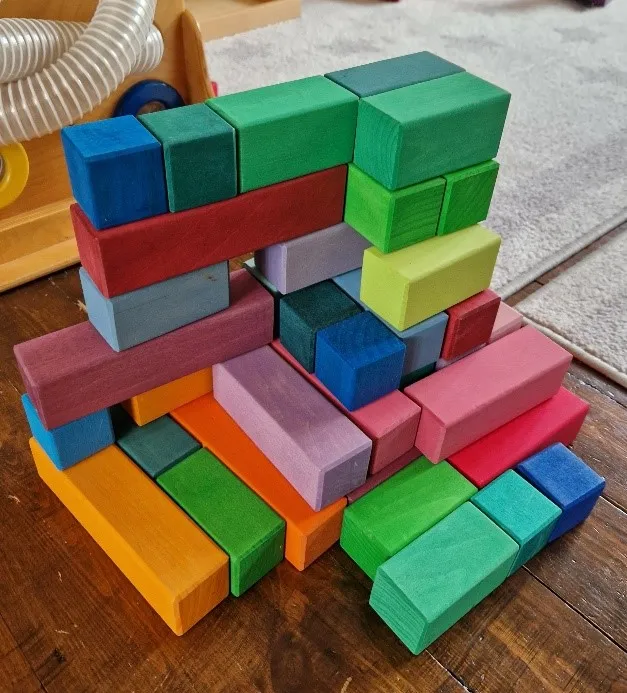
More examples of children’s block exploration.
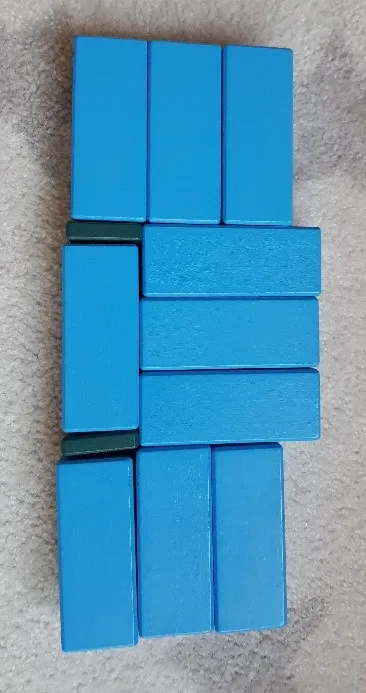
A structure made by a 3 year old. Child, aged 4 found blocks of the correct size to fill in the gaps in this symmetrical arrangement.
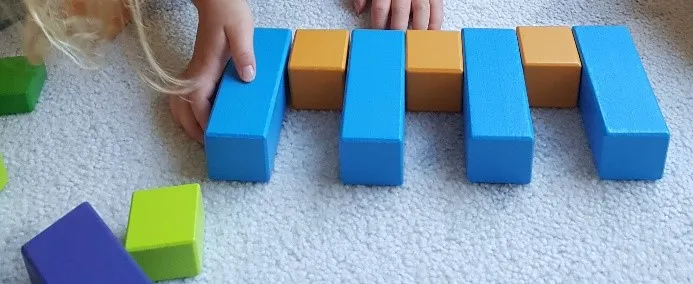
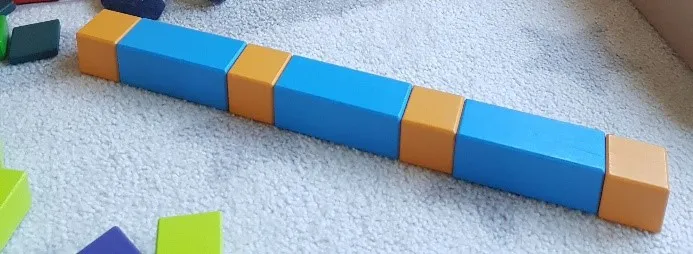
Using blocks to explore repeating patterns. The child used the same blocks to make a repeating pattern of orange / blue and then found a different way to make a repeating pattern of tall / short while continuing with the same colours.
The EEF’s fifth approach, Facilitating Mathematical Language highlights “language was typically implemented while reading storybooks to children.” In the links below there are many links to support this area. Classic stories such as The Very Hungry Caterpillar, Where’s Spot?, Rosie’s Walk, Handa’s Surprise, Goldilocks and the 3 Bears and We’re Going on a Bear Hunt are all books which can facilitate mathematical language, covering concepts including size, days of the week, sequencing and positional language. In the links below there are links for many more mathematical picture book suggestions.
Remember Maths, it’s not just about numbers!
Links
https://educationendowmentfoundation.org.uk/early-years-evidence-store/early-mathematics
‘Spirals’ Developmental Progressions Poster https://d2tic4wvo1iusb.cloudfront.net/production/eef-guidance-reports/early-maths/EEF-Developmental-Progressions-Poster-1.0.pdf?v=1716536239
Supporting Early Mathematics in the Early Years Summary Poster https://d2tic4wvo1iusb.cloudfront.net/production/documents/ey-evidence-store/early-mathematics/supporting_early_mathematics_in_the_early_years.pdf?v=1716467678
https://educationendowmentfoundation.org.uk/education-evidence/guidance-reports/early-maths
https://www.mathsthroughstories.org/
https://www.gov.uk/government/publications/early-years-foundation-stage-framework--2
Suggested links for further information
https://help-for-early-years-providers.education.gov.uk/areas-of-learning/mathematics/numbers
https://child-development-training.education.gov.uk/ including module 6: Mathematics
https://www.froebel.org.uk/uploads/documents/Froebels-gifts-and-block-play-today.pdf
https://blogs.glowscotland.org.uk/sb/earlylevelportal/7-stages-of-block-play/
https://earlymaths.org/ including https://earlymaths.org/spatial-reasoning-keyrings/ and https://earlymaths.org/spatial-reasoning-toolkit-posters/ and book lists https://earlymaths.org/maths-picture-books/
https://www.communityplaythings.co.uk/learning-library/articles/building-blocks-brilliant