

From Evidence to Action: Transforming Reading Practice in a Childminder Setting Author: Anna Mardapittas, Registered Childminder
Background and Context
After being made redundant from my Human Resources role, I began childminding while my children were young. Twenty years later, I remain deeply committed to the Early Years, understanding that the first five years are vital for shaping children’s lifelong learning, wellbeing, and development.
Over time, I have:
- Completed my Level 3 Early Years qualification
- Became an Assessor for Levels 2 and 3
- Worked as a Mentor on the Covid Recovery Programme
- Joined the London South Early Years Stronger Practice Hub
To elevate my practice I have engaged with EEF evidence-informed approaches, particularly Interactive Reading, which I have since embedded across my setting to support the development of communication and language in my children which is so vital in underpinning all learning as our EYFS statutory framework reminds us,
“Reading frequently to children, and engaging them actively in stories, non-fiction, rhymes and poems, and then providing them with extensive opportunities to use and embed new words in a range of contexts, will give children the opportunity to thrive.” Early Years Foundation Stage Statutory Framework for childminders, p9, 2025
Drawing on EEF Evidence
London South Early Years Stronger Practice Hub Training and webinars such as “Designing and Explaining Your Ambitious Curriculum” and the regular childminder staffroom, encouraged me to explore the EEF Early Years Evidence Store further. They helped me learn more about Interactive Reading—an evidence-based approach proven to improve children’s language and comprehension. They gave clear examples of developing quality interactions around books with children at varied stages of development.
EEF Interactive Reading Focus
- Adults engage children in discussion around books
- Encourage prediction, questioning, and conversation
- Extend vocabulary through repetition and modelling
- Build children’s confidence and comprehension
Inspired by this, I introduced Interactive Reading sessions across my setting, embedding them within our daily routine during both adult led group and free flow situations. With my two assistants we chose books for our curriculum that would help introduce the language we had chosen to teach and enable our children to revisit and rehearse the new language. We wanted to boost our children’s communication and language and support a child with hardly any spoken language.
Implementing Interactive Reading in Practice
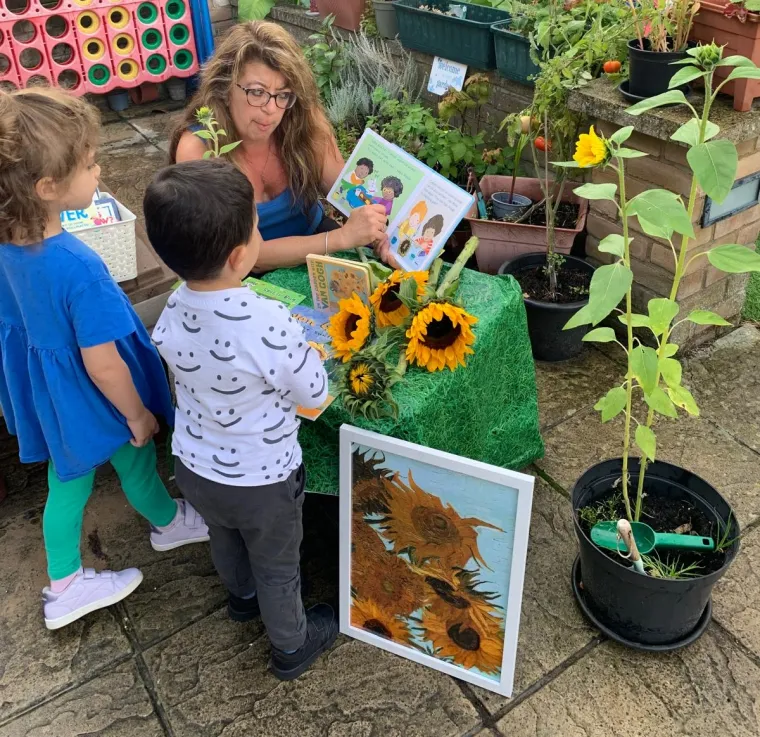
We now use carefully chosen core texts to connect learning experiences and encourage conversation. My assistants and I now regularly use texts to promote the children’s talking as opposed to only adults reading texts from cover to cover. The idea is to build the children’s ability to participate more and more over time. The more they speak about the book the more practice they get talking. We sensitively rephrase and repeat back correct language. One of our most successful examples has been the Sunflower Project, which connected reading, science, maths, and art whilst supporting improved language and communication in all the children. The motivation to speak was high and the supplementary books we provided gave ample opportunity for the children to talk about and around the books.
The Sunflower Project
Overview:
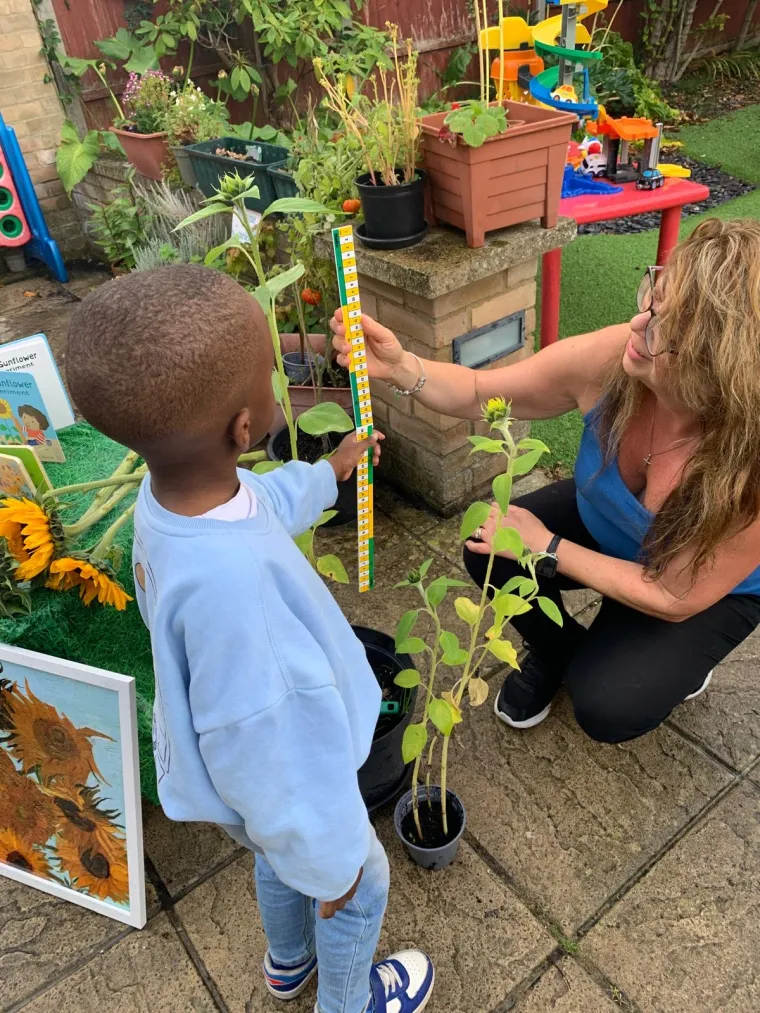
Children planted sunflower seeds, measured their growth, and observed changes over time. This inspired discussions about nature, size, and change—strengthening both vocabulary and understanding. We introduced, rehearsed, and revisited language using the recommended text Rosa’s Sunflower Experiment and had a selection of other books around the same theme to encourage revisiting the same or related language.
Linked EYFS Areas:
- Communication and Language
- Understanding the World
- Expressive Arts and Design
Vocabulary Focus
Planting and measuring sunflowers
Understanding the World / Mathematics
Stem, root, leaf, tall, short, seed
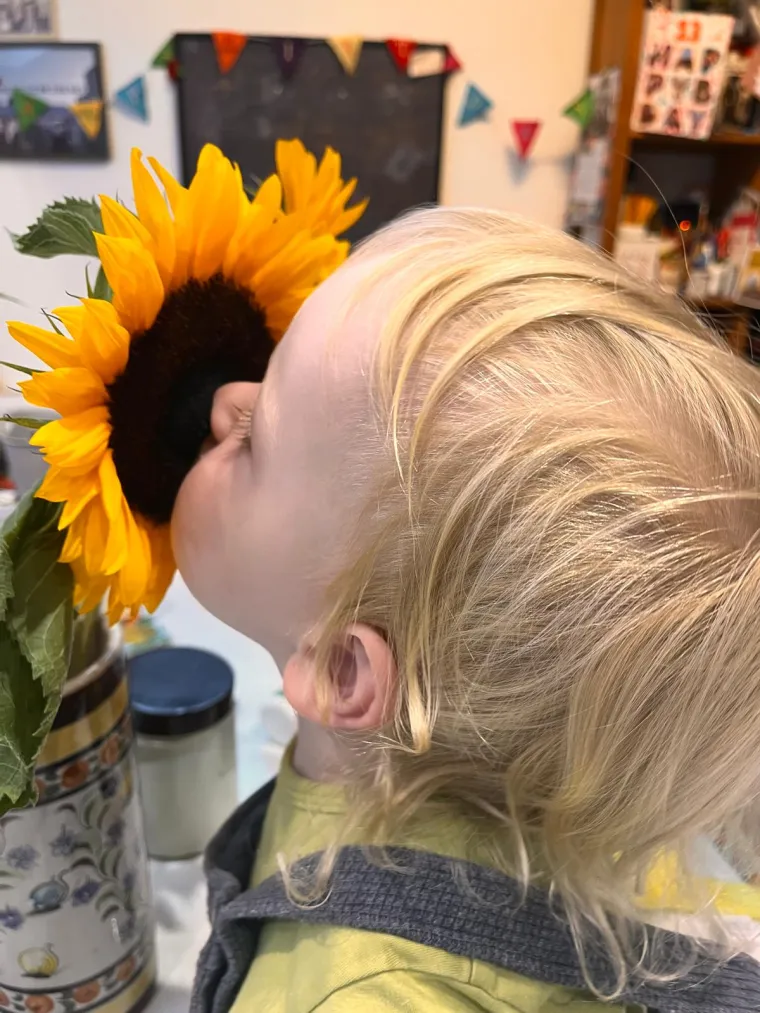
Painting sunflowers inspired by Van Gogh
Expressive Arts and Design
Petal, vase, colour, enormous
Reading books on growth and change
Communication and Language
Germinate, grow, sunlight, compare
Extending Learning through Mathematics and Executive Function
Following further training on executive function and mathematical thinking, my team and I reflected on how to extend language across all areas of learning.
Evidence-Informed Adjustments:
- Used books and loose parts to encourage talk around “more,” “fewer” “equal.”
- Modeled “thinking aloud” to demonstrate planning and reasoning.
- Encouraged children to reflect during transitions and tidy-up routines.
This reflects the EEF’s recommendations for building self-regulation through guided interaction and reflection, aligning with the EYFS Personal, Social and Emotional Development area.
Interactive reading success with a child of few words
We have an almost 3-year-old who started attending when he was 2 years old with no speech. We shared a variety of books including our core books and library books during circle time, in smaller groups and on a 1-1 basis. We noticed that he particularly enjoyed Dear Zoo. We created a story bag based on the Dear Zoo story which included the animals. We could tell that the child enjoyed the story from non-verbal signs such as smiling, pointing, flipping the flaps and making the sounds of the animals.
He can recite the words from the story now. The parents have also noted that he does this at home. The consistent approach of encouraging his speech whilst engaging with a book of his choice has led to him learning many words and regularly using simple phrases to express himself. Interactive reading has unlocked speech for him.
Here is an example of how interactive reading works with him:
As the adult read the book and paused, the child opened flaps and responded to the adult. There was lots of to and fro:
child : elephant
adult: and he was too
child : big
adult: so I sent him
child: back
adult: so they sent me a
child: giraffe
adult: he was too
child: too tall
adult: so I sent him
child: back
The adult repeats correct pronunciation after child for example ‘nake, snake / yion, lion’,
We have noticed that interactive reading with this child has had an impact over time on his communication and language. He now describes the narrative of a story using 3-5 word sentences depending on how familiar the story is to him. He can also engage in short sentence conversations with adults.
This way of working is consistent with the research evidence as described in the Evidence Store,
“Successful interactive reading interventions tend to involve the adult offering a prompt to encourage interactions between the adult reader and child(ren). Prompting is the act of drawing attention to something related to the book being read that encourages a response from the child, such as asking questions or allowing the children to complete the sentence. “EEF Evidence Store, Communication and language- approach 3, Interactive Reading
Engaging Parents in Interactive Reading
Parental involvement is crucial to sustained language development. Inspired by the “Bringing Stories to Life” EYSPH training, we introduced Story Sacks with props and text suggestions for families to use at home.
Parent Feedback In response to the sunflower project observations shared:
“What lovely activities and great photos—it never fails to amaze me how many different and varied activities my son does in a day.”
“I hope you know you are spectacular! Thank you so much for being a big part of our life, we are lucky to have you.”
This home–setting partnership reinforces the EYFS principle of working together with parents and ensures continuity in language learning.
Evidence of Impact on Children’s Development
Children aged 1.5–3.5 years demonstrated clear progress in their ability to use complex, descriptive, and comparative language. Through observation we were able to notice the progress of our children with their language and communication.
Examples of Children’s Language:
- “We put soil in, seeds in and more soil.”
- “Flowers need water.”
- “That’s the tallest one!”
- “There’s a bumble bee in the sunflower.”
Children now use:
- Longer sentences and richer vocabulary
- Scientific terms related to the natural world
- Increased confidence in conversation and storytelling
This aligns directly with EYFS Communication and Language early learning goals—listening, attention, understanding, and speaking.
Professional Growth and Recognition
Being evidence-informed and engaging with the Early Years Stronger Practice Hub has also contributed to our confidence and professional recognition.
I successfully achieved the Enfield Reading for Pleasure Excellence Award, with the following feedback:
“Anna provides an enabling environment where children have access to cosy, comfortable areas, a vast number of books displayed throughout the setting, along with supportive resources such as story sacks. There are effective story sessions as part of the daily routine as well as one-to-one story times. All children are included.”
This recognition confirms how evidence-informed practice has enriched my curriculum, my team’s confidence, and the children’s love of reading.
Summary of Impact
Focus Area
Approach and Practice
EYFS Link
Impact on Children
Communication & Language
Interactive Reading
Communication & Language
Richer vocabulary and more complex sentences
Understanding the World
Linking texts to real-life experiences
Understanding the World
Descriptive and scientific language use
Mathematics
Story-based problem solving and comparison
Mathematics
Greater use of comparative and counting terms
Self-Regulation
Modelling, reflection, and planning
PSED
Calmer transitions and improved self-esteem
Parental Engagement
Story sacks and home reading
Partnership with Parents
Extended vocabulary through home–setting links
Concluding Reflections
Engagement with the EEF Evidence Store and Early Years Stronger Practice Hub has transformed my setting into a language-rich, research-informed environment.
Key outcomes include:
- Children confidently using complex and descriptive language
- Adults applying evidence-informed strategies with intent
- A curriculum rooted in real experiences, meaningful dialogue and carefully chosen texts to implement Interactive Reading.
Interactive reading has proven to be a powerful tool for unlocking children’s curiosity and communication—and has enriched our entire setting’s approach to teaching and learning language.
Further Reading and Resources
- EEF Early Years Evidence Store – Communication and Language
- EEF Early Years Evidence Store – Self-Regulation and Executive Function
- Early years foundation stage statutory framework for childminders
- EEF blog: Interactive reading – More than just reading a book! | EEF
London South Early Years Stronger Practice Hub – Case Study Publication.