

Communication and Language, along with Physical Development and Personal, Social and Emotional Development are the 3 prime areas of the Early Years Foundation Stage (EYFS). As the EYFS states; “Three prime areas are particularly important for learning and forming relationships. They build a foundation for children to thrive and provide the basis for learning in all areas”.
The impact of the Covid-19 Pandemic on children’s speech and language development and the difficulties shown by children is well documented and there are still significant numbers of children in all settings who need additional support and targeted interventions in this area. The EEF evidence store has a section on communication and language and includes approaches and practices to support communication and language development in the early years. https://educationendowmentfoundation.org.uk/early-years-evidence-store/communication-and-language
This case study focusses on Child G, who is male, lives with both parents and has English as the only language heard and spoken within the home environment. It includes evidence from throughout their time in the Early Years phase including attending a childminder, PVI setting and transition into Reception along with partnership working with other professionals.
During the mother’s pregnancy with G, medical professionals became concerned about the foetus from 28 weeks and after numerous additional tests including an MRI, found there was an area inside the developing brain which had too much fluid. These findings meant the parents were offered to legally terminate the pregnancy at 33 weeks. Child G was born prematurely at 35 weeks and after treatment for jaundice in High Dependency Special Care was discharged from hospital after 9 days.
When child G was 4 ½ months old a fluid filled sack appeared on the back of his head which would move from left to right or when pressed such as sitting in a chair would move forward near his temples on both sides of his forehead. After more medical tests including another brain MRI, it was concluded it was a deep bruise caused by being stuck in the birth canal. It continued filling up and growing in size for another 3 to 4 months and after this started reabsorbing and had completely disappeared at 10 months old.
While Child G was under 12 months there was no concern about his progress or meeting developmental milestones although he was to the latter end of the ‘average’ range, especially as he had both his actual and his adjusted or corrected age to be taken into consideration. (Babies born prematurely can be assessed by their corrected age using their due date until they are 24 months old.)
At 12 months G started attending a childminder setting and enjoyed spending time interacting with other children, including attending groups in children’s centres. When G was around 18 months he only said a few sounds and occasionally a word. He developed some signs and gestures which were personal to him, such as opening and shutting his hand to mean come. At the 2 year old Health Visitor developmental check the only area of concern was delayed speech, but no referrals were felt necessary at this time as he was communicating. The childminder ensured they were providing a language rich environment including songs, rhymes and books, limiting background noise, ensuring the child’s attention had been gained with eye contact and implemented the Hanen OWL technique. The OWL technique is Observe, Wait and Listen, especially when not having an immediate response, by not repeating, rephrasing or adding another question. The childminder was using the graduated approach with four stages of action: assess, plan, do and review. They were using this cycle to help inform the child’s next steps and then assess the impact and progress the child made.
It wasn’t until G was around 29 months old that he consistently said “dada” and “mama” for the correct parent. At this time he was also starting to learn new words, however, they were all sounding very similar but he was able to join together two sounds which he was using to represent words.
Approaching his third birthday it became clear that G had made limited progress with his speech during the year and the language gap between G and others of the same age was dramatically widening and therefore now a cause concern. When aware of the context his mother understood approximately 75% of what G said verbally and she translated G’s speech for others, including G’s father who understood about 50%. Other adults, including the childminder understood between 10 and 20% of the words spoken. It was at this point a referral was made to Speech and Language therapy, for professional assessment and input, which also included a referral for a hearing assessment to check there were no underlying hearing issues.
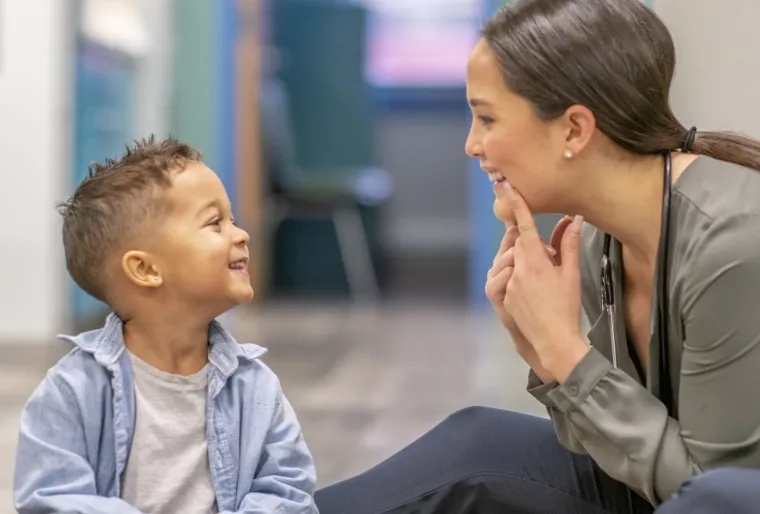
When G was aged 3 years 4 months, he attended his initial assessment with a speech and language therapist. The summary said ‘He presented with age-appropriate attention and listening, social skills, play skills and above average understanding of language. His expressive language was delayed and his speech was noted to be hard to understand.’ He then started weekly therapy sessions with his mother in attendance who would then relay to the childminder what the daily focus or ‘homework’ was until the next session, which the childminder incorporated into his Individual Education Plan (IEP).
When G had completed three cycles of Speech and Language therapy and had made limited progress a diagnosis was given of Developmental Verbal Dyspraxia (DVD) which in 2024 has been renamed as Childhood Apraxia of Speech (CAS). The Royal College of Speech and Language Therapists (RCSLT) states;
“Childhood Apraxia of Speech (CAS) is a rare motor speech disorder which reduces the intelligibility of speech. It is a subtype of the diagnostic category Speech Sound Disorders (SSD). Although CAS is a low prevalence condition, estimated to be 1 child per 1000, it has a serious and long-lasting impact. It is present from birth and will not resolve without specialist speech and language therapy intervention.
Children who present with SSD, including CAS, may be unintelligible even to familiar listeners. Therefore, as well as requiring remediation of their specific difficulty, they require support to communicate and interact effectively with those around them. Speech and language difficulties are known to impact learning and literacy and, if persisting into later childhood, peer relationships and social-emotional wellbeing.”
Some examples of his speech at this time include;
- ‘long time’ sounds like “war ter” (water) but ‘water’ is said “war war”.
- “Next morning choo choo out engine shed” with morning pronounced “morehair”.
- “Help me, I need to cut Dadda up!” said “cut” while indicating running which was ‘catch’.
Child G started preschool the academic year before reception to gain experience of a larger setting and to gather further observations by additional practitioners. He had a Communication Book made for him by his Mother with information for anyone who might come into contact with him, including in preschool with top tips which had been recommended by the Speech and Language Therapist. These were;
- I can understand everything you say and follow complex instructions.
- I use words, gestures and Makaton signs to communicate.
- Things you can do to help me:
- Make eye contact
- Listen carefully
- Repeat what you think I have said. I will say “yes” or “no”
- If you don’t understand ask me to tell you again, show or sign what I mean (there might be a picture in this book which will help)
- It’s OK to tell me “Sorry I don’t understand”.
- Don’t ask me too many questions.
- Sometimes I say “I gont know!” (don’t) or “I got” (forgot) when I do know and I remember, just so I don’t have to talk.
The transition to attending preschool for 15 hours a week was challenging both for G and the parent. The Local Authority SEN liaison reported:
“He showed his stress by needing to have the daily routine constantly confirmed and he also needed to carry his teddy bear comforter with him at all times. He constantly asked the time even though he can tell the time and could see the clock. He would often stand beside an adult as he found making the social connections with other children difficult.”
By the age of 4 G could use an analogue clock or watch to tell the time both in o’clock and half past independently and would watch and wait for the minute hand to reach the number an adult had told him.
G knew his daily and weekly routines by heart. However, if something changed, such as when he started preschool, it took him a while to adapt. He needed extra support, until the routine became embedded, both by staff answering questions on the routine and referring to a visual timetable. He decided when he no longer needed to constantly refer to the timetable. G also liked to plan things in advance and could name the days of the week and was starting to know the months of the year so he could plan events important to him.
He built a strong relationship with his keyworker and found Monday the hardest day as his keyworker wasn’t there. However, sometimes he used this to his advantage as he was rarely challenged or pushed to do something he didn’t want to on that day. At preschool G didn’t readily play with other children, only occasionally would he mention another child’s name. G learnt the names of the members of staff, however he sometimes referred to them by identifying features such as “my teacher with the big watch” instead of their name. G found any speech activity or mark making difficult.
The speech and language therapy report at the end of preschool identified, ‘He has difficulties in
- His use of appropriate grammatical structures
- His interactions with peers and unfamiliar adults
- His production of intelligible speech’
Examples of G’s speech in preschool include:
- when joining in with ‘What a Beautiful Day’ from We’re Going on a Bear Hunt, G said “boot day” instead of the whole phrase.
- “cut” meant ‘shut’,
- “tool” for ‘school’
- “op” for ‘stop’.
G was however talking in long phrases if they could be understood. As he said to his Mother at night time while being put to bed; “My need big light on read my book. Can’t see words. My need one more book”.
The preschool report said;
“Child G’s difficulty in forming words has prevented him from fully engaging with other children and has led him to playing alongside others or spending time with adults. He is an enthusiastic singer and can often be heard above all the other children. Although his fine motor skills appear appropriate for his age he still needs support when attempting to use a pen to draw or write.”
Child G got increasingly frustrated at his attempts at verbal speech not being understood and would frequently express this to either his key worker or parents, however he never displayed this to other children.
In February the parents applied for a needs assessment as in the SEND Code of Practice DfE 2015;
“4.57 The Local Offer must include information about how to request a needs assessment for an EHC plan. A request is likely to happen where special educational provision currently being made for them by their early years setting, school or college from their own resources, is not enabling the child or young person to make adequate progress.”
The first application was rejected, however with support and additional evidence from all the professionals working with G including key worker, SENCO, Inclusion team and Speech and Language therapist the EHCP was finalised in October, a few weeks after G started Primary School.
The transitions were sensitively planned for the benefit of G when he moved into reception. This involved the School SENCO, the class teacher, teaching assistant and allocated 1 to 1 support staff to aid a smooth and seamless transition so there was no negative impact on the child and they could sustain the progress he was making towards his targets.
Great partnerships formed between the parents and early years staff including the childminder, and the staff in the PVI setting including key worker, SENCO, manager, deputy manger. The Local Authority SEN and inclusion specialists who have a variety of job titles and the NHS support of Speech and Language Therapist was invaluable. A Local Authority appointed Educational Psychologist and later an Occupational Therapist also became involved.
The Educational Psychologist stated “Child G is a good communicator, using long utterances, although mostly unintelligible words. He is described as doing ‘a lot of talking’ by the nursery. I could understand his ‘drift’, such as I heard him ask his dad about “pay pad pool”, meaning ‘playing in the paddling pool’. He can sign, tending to use this for a few words, such as ‘no!’, ‘digger’ and ‘sorry’.
G didn’t achieve all the Early Learning Goals in their Foundation Stage Profile at the end of the reception year.
G has now left the Early Years has also received diagnoses of Developmental Coordination Disorder / Dyspraxia , Autism and Dyslexia. He continued in mainstream education with additional support provided through his Education Health and Care Plan. His latest Speech and Language therapy assessment report still identifies that he is at risk of expressive language difficulties and might find it difficult to express himself using spoken or written language. The strategy to be used is ‘repeat or extend his spoken sentences in a grammatically correct way’. This reminds me of ‘High Quality Interactions in the Early Years - The ShREC approach’.
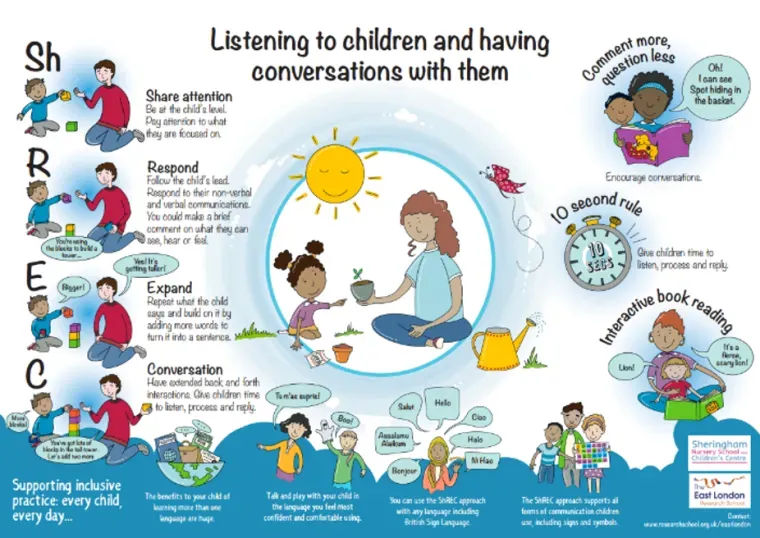
Our Top Tips for supporting early interactions | Stronger Practice Hubs
What’s in the Bag? to build vocabulary and language | Stronger Practice Hubs
EEF | Communication and Language (educationendowmentfoundation.org.uk)