

Debbie Brace -babytalkandplay- Founder/Creator.
Historically a qualified teacher, Debbie Brace works directly with babies and their families as well as the early years education workforce. Graduating with an MA in ‘infant mental health’ from the Tavistock and Portman NHS trust, she is also an accredited Video Interaction Guidance (VIG) practitioner. Debbie’s attachment and psychoanalytic informed approach inspire parents/carers and early years professionals to have meaningful interactions and strengthen bonds between babies, young children and their caregivers giving them the best chance of developing positive foundational relationships alongside early language skills.
There is no such thing as a baby!
How we play, talk and respond to the babies in our care whilst at work is important and this is obvious. What is less obvious is why this makes a significant contribution to their mental good health. This sounds serious and it is! As Paediatrician, Dr Donald Winicott (1958) infamously states ‘There is no such thing as a baby!’ When he first mentioned this at a scientific meeting of the British psychoanalytical society back in the 1940’s, his fellows, we can imagine, thought he was saying something unintelligible and daft. ‘Of course, there is such thing as a baby! My wife has just had one!’ I like to imagine they muttered under their breath as he continued to speak. But what he actually meant stays with me and is the central theme to the first in this Being with Babies series.
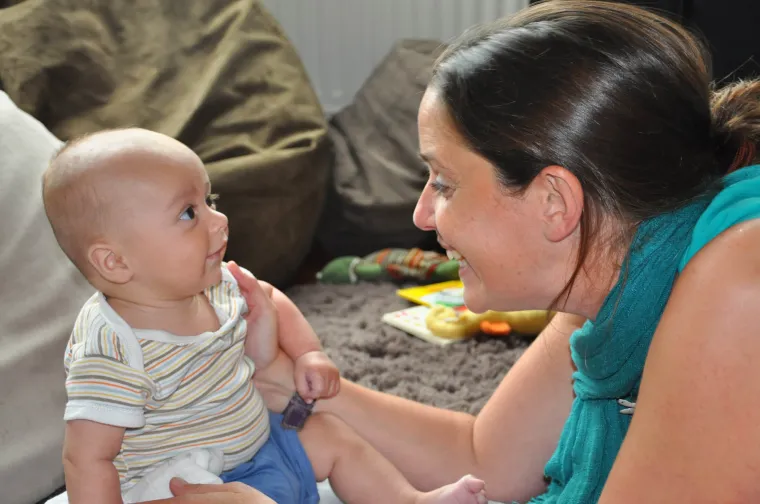
A baby can only exist if they are with someone else. All babies are emotionally vulnerable by default. They need another responsive, thinking human mind to hold their mind in their mind and wonder about them from their point of view and then communicate this wondering to the baby. And it can’t just be anyone- it has to be someone special like a key person or parent who is uniquely invested in the individual baby’s development.
This responsiveness is described as Mind Mindedness (A term coined by Dr Elizabeth Meins and psychology colleagues when researching what young children need to develop secure attachment relationships with their carers) Mind mindedness is now understood to be foundational for a mentally healthy baby/young child as well as be exactly what they need for typical early language skills to develop. The importance of this capacity or ‘space’ in this special someone’s mind firstly to wonder and secondly to communicate with the individual baby about what they think they might be experiencing, help the baby to make sense of their feelings and thus themselves. This is why mind mindedness and what it means and how it affects the infant‘s emotional development needs to be promoted, exampled and more explicitly understood by those working with babies.
What does this look like in practice?
In my experience, baby educators often demonstrate an incredible capacity for the first part of being mind minded. They know their key babies well and can explain in detail what they are communicating through their non-verbal behaviour and anticipate and interpret what they want or need moment by moment.
‘Fahim is arching his back and trying to wriggle out of his chair, he wants to get down from the table now because he has seen that his bed is ready ‘
‘Suki is pointing to the shelf and crying out because her comforter is up there. She always needs to have it for a bit before she goes to sleep.’
‘Tomas is a bit off his food and quiet today and keeps crawling over to the door I think because he wants his mum to come back- he has been on holiday for a few weeks, and this is his first day back.’
What I have observed to be less common is educators talking directly to their key babies about how they might be feeling thus acknowledging directly and specifically to them that they understand how they might be feeling. (another fundamental for development of a secure sense of self)
‘Fahim, you have seen your bed! You are frustrated that you can’t get down right now’
‘Oh Suki, you really want your rabbit, you need to hold onto it when you are feeling tired don’t you.’
‘Tomas, You are by the door again……. maybe you’re wishing your mummy would come back right now!……. It’s hard to come back from holiday and come back to nursery isn’t it.’
Sounds simple?
Although the term mind-mindedness may sound simple, it is, in fact, a complex concept. There are several reasons why carers may find it difficult both to observe and to acknowledge babies’ feelings, particularly when babies are communicating distress (Brace, 2020). This is something we will explore in more detail in a later blog. For now, however, let us agree with Winnicott that there is indeed no such thing as a baby without their carer. This is why, when we choose to spend our time thinking about and being with babies, and we take the time to talk directly and specifically to them about how we think they might be feeling, we are doing one of the most important jobs in the world.
Find out more through the Association of Infant Mental Health UK. https://aimh.uk/ AiMH UK is committed to promoting the importance of infant mental health (IMH) and early relational health, while supporting the ongoing professional development of practitioners, IMH teams, early years workers, educators and students focused on improving outcomes for parents, babies, and toddlers.
Next blog- Being with Babies –Getting Group Singing and Rhyming Right
References
Brace, D. (2020). ‘Settling In’: Exploring the complexes of observing and responding to young children’s communicators of distress as they start day care, Infant Observation 23 (3),pp. 133-148.
Meins, E., Fernyhough, C., Fradley, E., Tuckey, M. (2001) 'Rethinking maternal sensitivity: mothers comments on infant’s mental processes predict security of attachment at 12 months’, Journal of Child Psychology and Psychiatry and Allied Disciplines, 42(5), pp. 637-648.
Winnicott, D. W. (1958) Collected papers through paediatrics to psychoanalysis. London:Tavistock Publication