

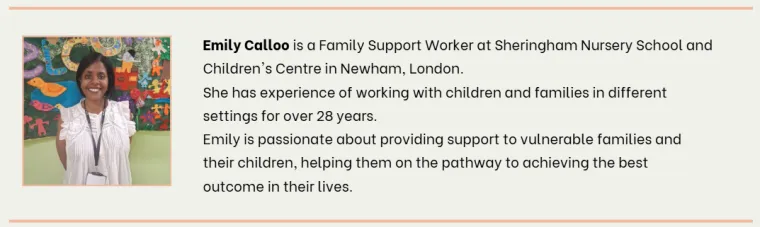
For some families, taking up a nursery place can feel like a big step. Best Start in Life practitioner Emily Calloo explains how she worked alongside a mother experiencing anxiety, helping her build confidence in her son’s transition to nursery.
Rahima and Hasan
One of our parents, Rahima, had complex health needs and experienced significant anxiety. Hasan, her son, was presenting with speech, language and communication delays. Rahima is a single mother.
Although I recommended that Hasan attend nursery to support his development, Rahima was reluctant due to her anxiety and concerns about his needs being met.
Assessment
I realised that Rahima’s reluctance to enrol Hasan in nursery was due to her anxiety. She explained,
"I’m so worried that no one will understand his needs."
Rahima required a lot of reassurance that her son would be safe, well supported and able to thrive in a nursery environment.
I recognised that it was important to work at a pace that Rahima felt comfortable with, empowering her to make an informed decision.
Interventions
The EEF guidance report Working with parents to support children’s learning emphasises how important it is to work in partnership with parents to help their child’s learning. The report suggests that we should use respectful and encouraging language when working with parents and carers and avoid making them feel blamed or judged. Helping parents and carers to feel confident that they are valued partners can make a difference.
I had regular, gentle conversations with Rahima, being careful to take one step at a time. I specifically focused on the support that nursery would provide for Hasan’s speech, language and social communication skills.
Rahima was heartened to see other children in the nursery with similar needs to Hasan and the positive way that staff responded to them. She was interested in the visual timetables and commented about how well they would work for Hasan.
Over time, Rahima began to feel less anxious:
“I can see that the staff are so experienced in supporting children with additional needs, and they’re so kind. I feel much less anxious now.”
To further reassure Rahima, I arranged a home visit with Hasan’s health visitor. She had gentle conversations with Rahima, responding to her concerns about Hasan’s feeding and sleeping challenges. The EEF guidance report Working with parents to support children’s learning suggests that home visits for younger children with greater needs can be an effective approach for parents and carers who may struggle to attend meetings, and for building positive relationships.
We then had a TAF (Team Around the Family) meeting with the nursery SENCO. With Rahima’s agreement, this took place in her family home. Rahima had the opportunity to ask questions and gain a better understanding of the support and strategies that the nursery could provide for Hasan. She was especially pleased that there was a long settling in period adapted to Hasan’s needs, and that she could have visual resources at home to support her during settling in.
While Rahima was considering her options, I encouraged her to attend ‘Stay and Play’ sessions at her local Children’s Centre. Initially, I accompanied her to help build her confidence. These sessions enabled Hasan to interact with and play alongside other children in a safe environment. As well as this, Rahima began to make connections with other parents.
Over time, Rahima’s confidence developed: she became comfortable attending sessions and commented about the positive impact that they were having on Hasan’s development:
"I can already see him becoming more confident around other children. I'm so glad we came."
Outcome
Following consistent support and reassurance, Rahima decided to enrol Hasan in nursery.
I did a handover with the nursery teacher and Hasan’s key person. With Rahima’s consent, we spoke about her anxiety and how she would need some reassurance.
Hasan’s key person, Farhana, arranged a home visit before his first day. Farhana discussed the nursery routines, settling in sessions and outlined some of the nursery’s policies. She reassured Rahima that they would always be there to respond to her questions or concerns.
Hasan’s start
Hasan started in the 2-3-year-old room in September 2025 and will move to the 3-4-year-old room in September 2026. Rahima has not shown any signs of anxiety about this.
Throughout the year, I continued to support Hasan and arranged another TAF meeting before his transition into the next class. During the meeting we shared information and discussed Hasan’s progress. Rahima was grateful for the support we had offered to Hasan and confident that it would continue.
Rahima told us how happy she was that she had made her decision in favour of nursery. She said she had noticed significant improvements in Hasan’s development and had enjoyed supporting Hasan at home (using approaches and resources that the nursery had suggested). We said how this will have contributed to Hasan’s progress. Research from the Effective Pre-school, Primary and Secondary Education Project (EPPSE) shows that children’s cognitive and language development at ages 3–4 is strongly linked to positive parental interaction at home.
Want to know more?
Education Endowment Foundation (EEF) Guidance Report: Working with parents to support children’s learning
Education Endowment Foundation (EEF) Teaching and Learning Toolkit