


Saifan is 3 years and 5 months. He likes animals, dinosaurs and sea creatures. Saifan is used to my presence and interacting with me.
One morning I noticed Saifan playing with a box of farm animals. I wanted to try to use the opportunity to help develop Saifan’s understanding of one-to-one correspondence and language skills.
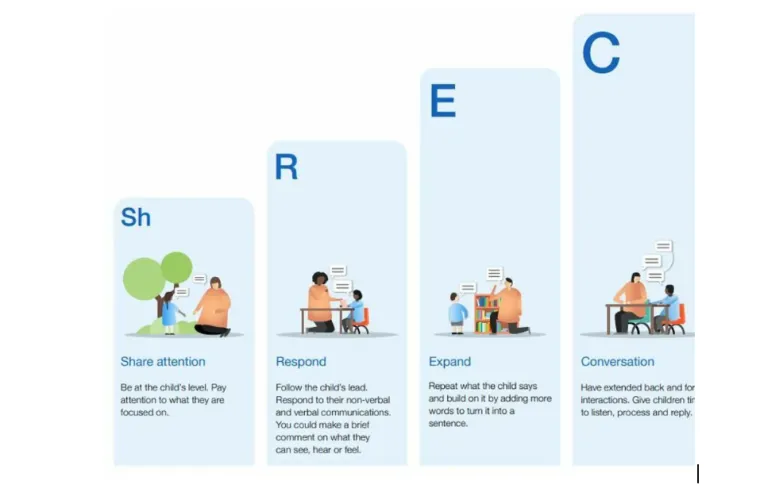
My interventions were guided by the four strategies of the ShREC approach. This enabled me to support his language development as well as his mathematical understanding.
Our conversation
I walked over to join Saifan, making sure I wasn’t too close. I didn’t want to disturb him or intrude.
Saifan was engrossed in his play. I showed my interest in what he was doing by watching. He saw me doing this and looked towards me. He carried on playing contentedly.
Here I was sharing attention with Saifan, and Saifan knew this. He looked back a couple of times to see if I was still watching.
I moved over and knelt beside Saifan so that I was on the same level as him.
S: A farm
M: You’re making a farm, Saifan.
Here I responded to Saifan’s interaction – I followed his lead and made a brief comment.
S: Mommy cow. Baby cow. Baby cow.
He pointed at each of them as he spoke.
M: Yes, one mommy cow and two baby cows.
S: 1, 2, 3.
Saifan paused, tapping each animal
Here I extended Saifan’s language by building on what he said - I continued to do this as we played.
M: You’ve got three cows: 1,2,3.
I pointed to each animal as I spoke.
Saifan picked up a chicken and looked at it closely.
S: Daddy chicken. Cock-a-doodle-doo.
Saifan put the chicken on the window ledge.
M: You’ve got a daddy chicken.
S: Cluck, cluck, cluck.
M: Your chicken is clucking. Cluck, cluck, cluck.
Saifan put one more chicken on the window ledge – he was smiling
S: 1, 2
He pointed to each animal as he said this.
M: You’ve got two chickens here and three cows.
I pointed to each animal as I spoke.
S: Quack, quack. Moo moo.
Saifan giggled.
M: The two chickens are quacking, and the three cows are mooing.
I pointed to them as I spoke, smiling.
M: Let’s find another chicken in the box.
We both rummaged in the box. Saifan found one.
S: Here!
M: You found it - now you’ve got three chickens: 1,2,3
I pointed to the chickens as I counted.
S: Three chickens (he pointed to them); three cows (he pointed to them).
M: Yes, you’ve got three chickens and three cows.
S: Moo, moo, moo. Cluck, cluck, cluck!
He laughed as he looked at me, I joined in.
Saifan and I had an extended back-and-forth conversation. I was mindful of giving him time to reply and process the words and concepts.
Saifan’s mathematical understanding
Our conversation helped to develop Saifan’s understanding of one-to-one correspondence.
As I counted the cows and chickens, I modelled pointing to each animal as I said the numbers aloud, demonstrating that each object is counted once. Saifan began to imitate this strategy, pointing to the animals while saying ‘1, 2’ and later identifying ‘three chickens and ‘three cows.’
A particularly useful idea from the Education Endowment Foundation is that young children may be able to count well but not understand that each number corresponds to one object when they count.
Through these shared counting experiences, Saifan began to connect the number words with the correct quantities. He was also able to compare two groups that contained the same number of animals.
Using play that he enjoyed and was familiar with helped to maintain Saifan’s engagement, allowing him to practise one-to-one correspondence in a meaningful and enjoyable context.
What next?
Saifan is now independently able to match number words to objects. This suggests that he is beginning to develop an understanding of cardinality.
I will now focus on extending to numbers beyond three and introducing comparison language such as ‘more than’ and ‘fewer than’.
Questions for reflection
- Can you think of a child who would benefit from input on one-to-one correspondence?
- How might you go about this during their (child-led) play or everyday activities?
Want to know more?
EEF Evidence Store: Early Mathematics
EEF Guidance Report: Improving Mathematics in the Early Years and Key Stage 1