

The EYFS Statutory Framework requires settings and educators to ensure that ‘every child is included and supported’.
In the early years, educators continually tailor their interactions with children to take account of each child’s learning strengths and needs. You can find out more about this in the EEF’s guide Improving early education through high-quality interactions.
Research evidence from the EPPSE Project suggests that older children in the EYFS benefit from more adult-led teaching and guided play. ‘Adaptive teaching’ is a way of ensuring that all children benefit from this adult-led or adult-guided learning. In the case study below, you can see an example of adaptive teaching to help children learn early maths at tidying up time. The same conversation helps one child who ‘has an answer’ and another child who seems to be stuck.
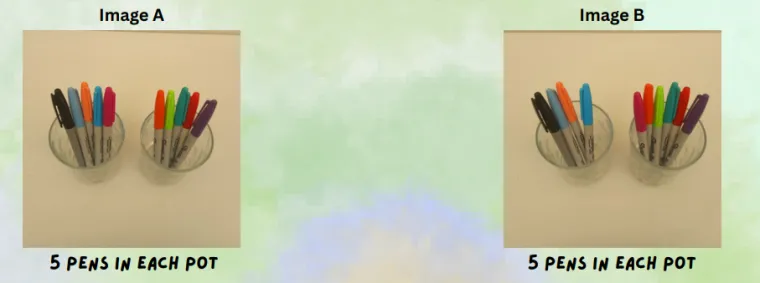
It’s tidying up time in the nursery and there should be 5 pens in each pot. Reaz and Safia, both four years old, are in charge of the pots.
Look at image A: Reaz sees a pen is missing and wants to fetch another one from the cupboard. Safia notices there are 6 pens in one pot so she can move a pen across. No new pen is needed.
Look at image B: Safia moves a pen from the pot on the right into the pot on the left.
The educator who is supporting the children at tidying-up time, Rizwana, engages both children in a conversation.
Rizwana: What's the same?
Saifa: when I moved the pen from that pot, each pot had 5 pens. That’s the same.
Rizwana: Did we need to get an extra pen from the cupboard?
Reaz: We needed an extra pen because that pot had 4 and we needed 5.
Rizwana: What did you notice about the number of pens we had all together, Safia?
Safia: We had 4 pens and 6 pens, and that was 10 all together.
Rizwana: ok, so do you think you can have 10 pens all together by having 4 pens and 6 pens Reaz?
Rizwana moves a pen so there are 4 in one pot and 6 in the other. Reaz counts the pens. First Reaz counts 4 pens, then she counts 6 pens.
Rizwana: I see what you mean, you counted 4 pens and then 6 pens.Safia, what happens if we count them all together?
Safia counts the 4 pens in one pot, and moves onto the next pot, counting on: 5-6-7-8-9-10 Rizwana does the same, and at the end she uses a circular hand gesture that goes round both pots as she says ‘that’s 10 all together’
Next Rizwana moves a pen from one pot to the other, so again there are 5 in each pot. She asks Reaz to count them ‘all together’, using the circular hand gesture again. This time, Reaz counts up to 5, and then counts on: 6-7-8-9-10.
Rizwana: Can you show us another way, Safia?
Safia moves pens between the pots, so now there are 7 pens in one pot and 3 in the other. She counts the two groups
Safia: (laughing) it’s 10 again!
In this example:
- Rizwana helps both children to practise their counting, pairing one item with one count word
- Rizwana helps Reaz to understand that a set can contain two groups, and that the last number reached when counting a set tells you ‘how many’ there in the set
- Reaz is beginning to understand that numbers can be broken apart and put together in different ways (the ‘part-whole relationship’)
- Safia already understands the part-whole relationship. Rizwana is helping her to deepen her understanding of this. Both children are learning together, through the same conversation.
By Ginny Reddick and Caroline Vollans