


Shuayb had a real fascination with books and spent long periods of time looking at them. He got to know his favourites very well, sometimes word for word.
Shuayb is autistic. He was my key child and loved to read with me. It was a time when I felt attuned to him and able to share attention with him. This is the first strategy of the evidence- informed ShREC approach.
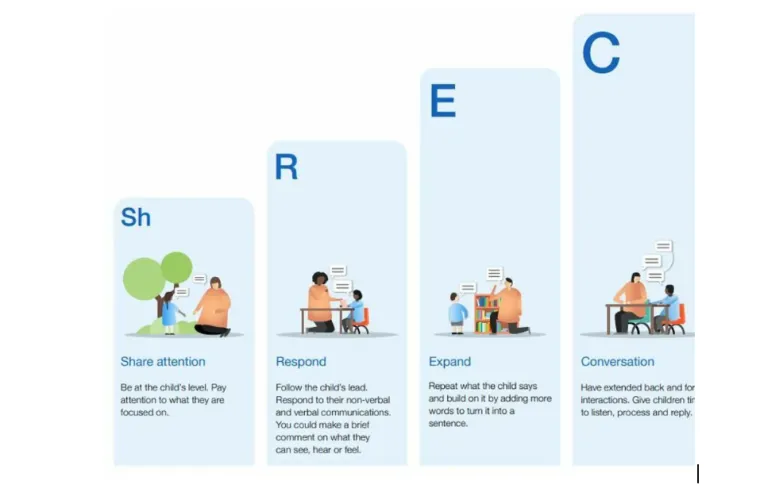
In her blog about the ShREC approach, Fliss James (2025) describes some ways to share attention:
“Getting down to the child’s level and engaging in their choice of activity provides a crucial opportunity to pay attention to what they look at, what they do, and what they say. Sensitively joining in with a child’s play motivates them to communicate with you." (EEF)
Reading ‘Where’s Spot?’ with Shuayb
Shuayb and I were reading Where’s Spot? together, one of his real favourites.
Shuayb turned the pages at quite a pace. Because I knew this about him, I had to plan my responses and expansions (the 2nd and 3rd strategies of ShREC). I learned how to do this over time: though it may look intuitive, it isn’t - it takes a lot of practice.
Julian Grenier (2024) highlights this:
“Experienced practitioners can make high-quality interactions look natural and effortless. But they are not easy to do well.” (EEF)
Maintaining Shared Attention with Shuayb when another child joined
As we were reading, another child, Fatima, joined us. I wanted to maintain shared attention with Shuayb, without dismissing Fatima.
I tried to navigate this by staying with Shuayb’s pace, responding to and extending his comments as I always do. I interacted with Fatima using non-verbal communication like making eye contact and smiling. This enabled her to be included as well as making sure I didn’t lose the moment with Shuayb.
As Fatima made comments, Shuayb continued going through the book. Fatima’s presence didn’t change our interactions. He seemed comfortable and calm.
The importance of my professional knowledge and relationship with Shuayb
It was great to see that Shuayb was able to let Fatima be part of our story time. He seemed to know that Fatima’s presence and involvement wouldn’t change anything between him and me.
I think this was because I knew Shuayb well, and he did me. He felt comfortable and confident that I was with him, doing what I always do. He was engrossed and keen to finish the book.
The strategies of the ShREC approach informed and enhanced my practice and interventions, though I think that my knowledge of Shuayb and our strong relationship were also central to its success.
As Julian Grenier writes:
‘What makes the biggest difference to a child’s early education?
It’s not just resources or the learning environment—it’s the knowledge, practice, and decisions of educators themselves.’
Shuayb’s language and social development
Towards the end of the year, Shuayb was saying more elaborate sentences, playing with groups of children (including saying their names) and joining in with singing.
It was inspiring to see the development of Shuayb’s social interactions. There was a big jump from when he started at nursery to when he left. I think his language development played a big part in this, as he learned to express himself using words as well as gestures.
The EEF’s Early Years Evidence Store says: ‘there is strong evidence that interactive reading can improve language and communication in the early years’. In particular, the EEF’s downloadable evidence summary notes that ‘the evidence is very strong around the efficacy of this approach for pupils experiencing poverty and those with less developed oral language.’
Shuayb has now moved on to Reception where he’s doing well.
Reflective questions
- Think of a child you know well – how do you think your knowledge of them is an asset to your practice?
- How might you plan your responses and expansions with a child who likes to ‘race’ through the book?
Want to know more?
James, F. (2024): Interactive Reading: the power of sharing books East London Research School.
Storybooks and games: practical resource to support Interactive Reading. BookTrust