

Emilia is three years old and communicates by using sounds and gestures. She loves to climb in the garden and enjoys back and forth interactions with an adult. Emilia’s play usually involves repetitive movements or actions.
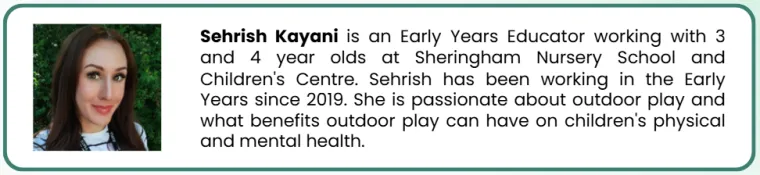
Here is a conversation that Emilia and I had during a happy time in the garden. Throughout, I am guided by the ShREC approach and indicate which strategy I am using, and why.
Interacting with Emilia: how I adapt the ShREC approach
Emilia is in the garden by the climbing frame. I walk over and get down to her level, showing her that I am interested in what she is doing.
Here I am following the first step of the ShREC approach - Sh- Sharing my attention with Emilia. This is especially important when encouraging children to communicate.
Fliss James (2025) point this out:
“Getting down to the child’s level and engaging in their choice of activity provides a crucial opportunity to pay attention to what they look at, what they do, and what they say. Sensitively joining in with a child’s play motivates them to communicate with you.’ (EEF)
Sehrish: I use my hand and thumb to sign Hello Emilia.
Emilia: puts one foot on the climbing frame and reaches her hand to me.
Emilia is replying to me, so I respond using the second step of the ShREC approach - R -Respond.
Sehrish: “Oh, I can see that you want to climb up.” I walk my fingers up my hand to gesture climbing.
I offer Emilia my hand and follow her lead.
Emilia: holds my hand. She starts to climb up but becomes a bit wobbly.
Sehrish: “Ooh it’s wobbly! You’re moving from one side to the other. Wibble-wobble! Wibble- wobble!” I start to wobble myself to show Emilia what I mean by wobbly.
“We’re nearly there. Two more steps: 1 ... 2!” I use my hand to show her one finger, then two.
Emilia: becomes excited, looks at me and shakes her hands from side to side, making sounds.
Sehrish: I look at Emilia and respond, “You’re very excited and smiling - being wobbly is making you happy.” I point to the emotion picture on my lanyard that shows a happy face.
Emilia: looks at it and smiles. “Ahhh Ahhh… Eeeee! “
Sehrish: “Ahhh Ahhh… Eeeee! You’re shaking your hands!”
I begin to shake my hands as well.
I am continuing to use the Respond strategy by copying Emilia’s sounds and actions.
Emilia: climbs up to the top and sits down on the climbing frame. She explores a toy she’s holding.
I wanted to take this moment to see if I could use the third strategy of ShREC – E - Expand: building on her play experience and introducing a couple of new words.
Sehrish: “You’ve found a leopard! A spotty leopard!” I use my finger to point to the black spots on the leopard.
Emilia: responds to me by holding my finger and using it to touch the spots.
Sehrish: ‘You are using my finger to count the black spots. There are so many black spots on the leopard… 1...2...3...4...5!” I use my hand and fingers to repeat counting to five using my fingers to show her: “5 fingers.”
Emilia: looks at me and, smiling, holds the leopard up to my face.
Sehrish: I make a roaring sound.
Emilia: becomes excited and begins to laugh and shakes her head and brings to leopard to her mouth.
Emilia: “Ahhh Ahhh… Eeeee!!
Sehrish: “You are shaking your head and eating the leopard! Ahhh, Ahhh, Eeee!”
I shake my head just like Emilia to show her that I recognise that she is communicating with me.
Here I am using the fourth stage of ShREC - C- Conversation. We are having back and forth interactions.
I find ShREC a useful guide for my interventions - though it may sound easy, each strategy takes practice and care.
Julian Grenier (2024) highlights this:
“Experienced practitioners can make high-quality interactions look natural and effortless. But they are not easy to do well.” (EEF)
Importantly, I tailor the strategies to suit Emilia’s needs - ShREC is not a rigid programme, but a framework that guides my interactions.
We need to celebrate the individuality of each child - using ShREC supports this.
Questions for reflection:
- What forms of non-verbal communication do you use when playing outdoors with a child - which are most effective?
- How do non-verbal children in your setting initiate communication - how might you respond and develop a conversation?’
Want to know more?
Grenier, J (2024): How can we support the quality of our interactions with young children? Education Endowment Foundation
James, F (2025): The ShREC Approach. Education Endowment Foundation
Royal Foundation Centre for Early Childhood (2025) ‘Back and forth interactions’
A Brighter Start EYSPH Wednesday Webinar with Prof Jenny Gibson (15th Oct 2025) Supporting children with diverse communication and language profiles in the Early years