

Maths is Magical: blog post 2
By Amy MacInnes, Early Learning Lead for Maths at the ELEVATE Stronger Practice Hub
Amy began her career managing a Maths and English tuition centre before moving into Early Years. She obtained Early Years Teacher Status and has led practice as Head of Early Years. More recently, Amy worked for a national training provider on their EYITT programme, assuming the roles of Tutor, Facilitator and Lead Tutor across the East, South East and London.
Welcome back to our Maths is Magical series—where we celebrate the joy, curiosity and wonder of early mathematical learning.
In our previous blog post, we explored how maths really is everywhere, and we gently unpicked maths anxiety alongside strategies to tackle it. Building on this, we are now going to look more closely at the skills children develop through effective maths teaching, as well as examine some common misconceptions that can arise amongst nursery teams and families.
The Education Endowment Foundation (EEF) highlights that a key aspect of improving mathematics in the Early Years is developing practitioners’ understanding of how children learn maths. Professional development is particularly important in early numeracy, and practitioners’ knowledge of both mathematical concepts and young children’s development plays a crucial role in supporting early learning.
Take a moment to reflect:
How confident do you feel in discussing and assessing young children’s mathematical development? Are you familiar with the developmental progressions that show how children typically learn mathematical concepts?
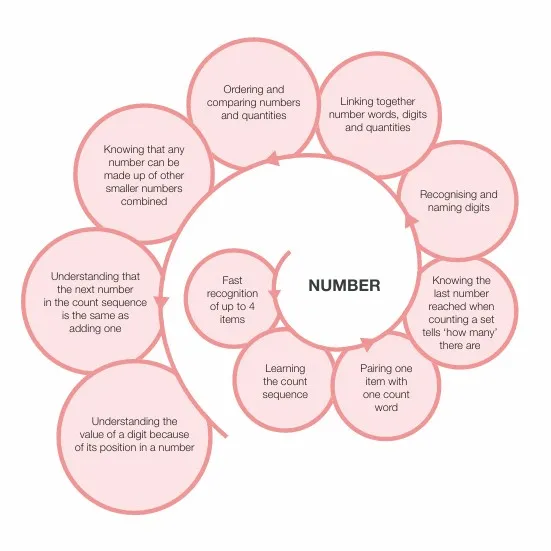
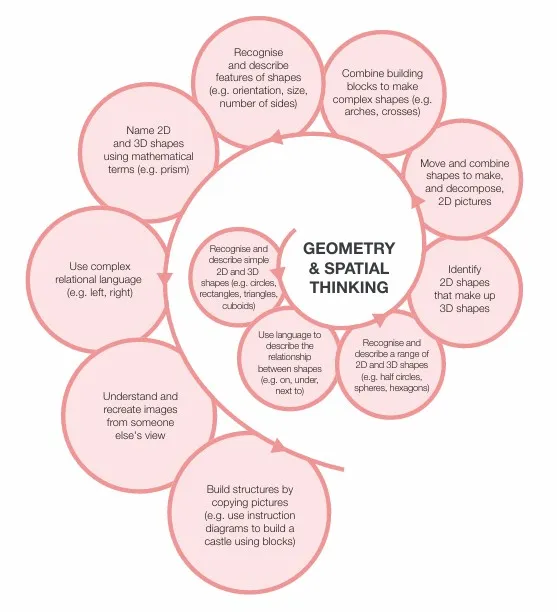
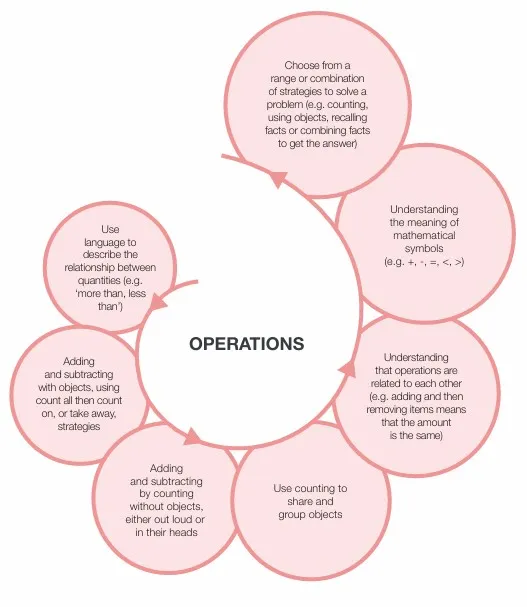
Below are three typical developmental progression spirals from the EEF, visually demonstrating how children’s maths learning progresses across the Early Years and into Key Stage 1. (NB- the diagrams are a spiral to convey that whilst there is some ordering in which these skills may emerge, development does not take place in clearly defined linear steps.) Take some time to digest these and reflect on any knowledge refreshed or newly gained. EEF-Developmental-Progressions-Poster-1.0.pdf
The Wider Skills Children Develop Through Mathematical Experiences
As stated on the Education Endowment Foundation, Mathematical understanding helps children to:
- make sense of the world around them
- interpret situations
- solve everyday problems (for example, sharing with friends)
Alongside this, many Characteristics of Effective Teaching and Learning are strengthened through rich mathematical interactions, such as:
investigating
having a go
taking risks
demonstrating curiosity
persevering when things are difficult
planning and testing different strategies
If children are presented with fewer opportunities to engage mathematically—both in child-initiated play and in play guided by a knowledgeable practitioner—they will naturally have fewer opportunities to develop these essential skills. These skills form a crucial foundation for children to become confident learners throughout their education and beyond.
🧩 Reflecting on Practice
Consider the mathematical opportunities currently available in your setting:
the indoor and outdoor environment
resources within continuous provision
planned mathematical activities
maths embedded within daily routines
mathematical vocabulary used in interactions
Now think about your colleagues’ engagement with these elements. What might they say? Could any misconceptions be influencing their mindset and practice?
⚠️ Common Misconceptions in Early Years Maths
babies and toddlers are too young to learn maths
maths is only for children who are ‘bright’
“I’m not a maths person”
maths in the Early Years is only about numbers
encouraging children to count as high as possible is the most important goal
You may have other examples of misconceptions that you have encountered when working with your team and families. Alongside maths anxiety, misconceptions can impact practitioners’ confidence and motivation to fully understand children’s typical mathematical development. Leaders and teams should take time to reflect on their own mindsets, discussing these openly to address them. Together, they can be overcome.
Early Maths teaching is all about giving the children the very best start in life, enabling them to have time and opportunity to develop their mathematical skills and learning, supported by knowledgeable and confident practitioners.
Don’t shy away from the conversation—empower yourself by engaging in maths‑focused CPD and share your learning with your team.
Join our fully funded Maths CPD Module to enhance your knowledge and confidence in Maths. Comprising of 6 e learning units and 4 seminars facilitated by myself over a period of roughly a half term.
The 6 units include counting, cardinality, measurement, pattern, shape and space- each of which takes around 2 hours to complete. After an initial welcome session, a live seminar (either virtual or face to face) will be facilitated after every 2 units completed to enable reflection, sharing of practice and action planning.
Spaces are limited, reserve yours today by clicking here!
Further Reading & Resources
Follow up by studying the resources and information available on the Education Endowment Foundation (EEF): Improving Mathematics in the Early Years and Key Stage 1 | EEF
Access the Early Years pages on the National Centre for Excellence in the Teaching of Mathematics: Early Years | NCETM
Take some time to refresh your knowledge of mathematical development here: Development Matters - GOV.UK and Birth-to-5-Matters-Doc-Artwork-PT-LINKS-Aug-26.pdf
Look on line at the Early Years Evidence Store for more information and practical applications: https://educationendowmentfoundation.org.uk/early-years/evidence-store/early-mathematics