

In this instalment, we discuss the evidence supporting the development of early language. Eileen Allpress is the Research Lead for the East of England Early Years Stronger Practice Hub. Prior to this, Eileen was a primary school headteacher and research director for Ipswich Research School.
"A child who enters school in the lowest 20% of vocabulary knowledge will need to learn 20 new words, every day for the next 3 years to catch up" Biemillar, 2011
To provide the key building blocks for reading and writing, a key focus needs to be placed on communication and language. Evidence shows that high quality interactions have an improved impact on all children but especially those from disadvantaged backgrounds.
Prioritising high quality interactions with children will help develop their communication and language. A key distinction is to think about those interactions when a practitioner is talking to a child rather than talking with a child. When done well, these interactions look effortless but they are not easy to do well.
‘If adults talk with children effectively—taking the lead from the child, elaborating on what they say, asking questions, sharing rhymes or songs or books— then children are given the best start in developing the cognitive tools they need to succeed at school’.
Early Intervention Foundation, The Best Start 2015 at Home.

Early reading should be developed using a balanced approach that focuses on language comprehension and decoding. Providing a rich environment will help support all aspects of early reading. Looking at the vocabulary strand, to make expected progress, children need to learn on average 7-8 new words a day.
"Reading the same book several times helps with language learning"
Horst et al, 2011
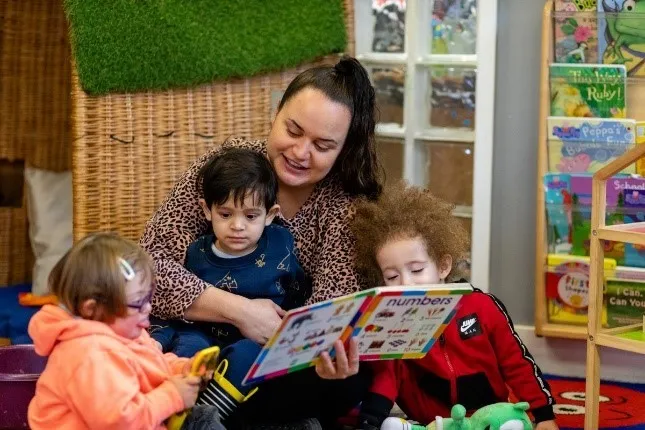
Hart and Risley (2005) suggest that children need to hear and use new vocabulary at least 50 times in a context that is meaningful to them in order to be able to say it.
One of the most effective ways to embed this vocabulary is by guided interaction between an adult and a child.
‘Guided interaction occurs when an adult and child collaborate on a task and the adult’s strategies are highly tuned to the child’s capabilities and motivations. Discussion is a key feature of this approach and the use of a variety of questions helps to develop and extend children’s thinking.’
https://educationendowmentfoundation.org.uk/education-evidence/guidance-reports/literacy-early-years
Reading the same book is helpful especially if questions are considered and planned before hand. The important thing is to read…read…read...
Story telling, developing letter and sound knowledge, singing and rhyming activities help develop phonological awareness. It is key to develop awareness of sounds before introducing phonics. The key layers of sounds are:
- Phonemes – the smallest parts of speech
- Onset and rhyme – rhyming parts of a word
- Syllables – beats within a word
- Words – units of meaning
- Phrases – groups of words
- Sentences – whole grammatically correct utterances

When a child has a good ability to manipulate these layers they can begin their phonic journey to support both reading and writing skills. Children benefit from a range of opportunities to communicate through writing. Evidence is clear that children need support for transcriptional skills (physical skills) and motivation for writing.
Most children first begin mark making just because they can! The muscles they use depend on their stage of development. Once you assess where they are, appropriate provision to support can be given.
These are:
- Shoulder pivot
- Elbow pivot
- Wrist pivot
When children are ready for letters it is suggested to teach in letter groups. Again giving a range of handwriting activities to motivate and encourage regular practice.
Finally involving parents and helping them understand the importance of reading and pre-writing activities.
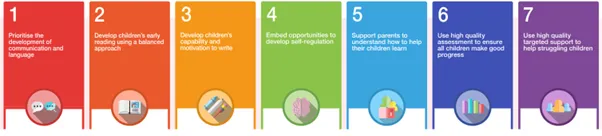
Visit the EEF Evidence Store to find out about approaches supporting Early Literacy: https://educationendowmentfoundation.org.uk/early-years-evidence-store/early-literacy