
Building Strong Foundations
How to support physical development in the Early Years
A blog by Eileen Allpress. Research Lead for the East of England Stronger Practice Hub.
Evidence from the EEF Early Years Evidence Store has shown that Early Years practitioners can implement approaches that impact positively in children’s physical development. There is also evidence that these approaches may also benefit their cognitive development. It is therefore important to consider how we, as Early Years practitioners, can take the initiative to help improve the physical development of the children within setting.
We can do this by identifying :
- the skills needed by the children,
- resources/environment needed to help develop these skills
- practitioners skills to support interactions.
What are the three skills children need to develop their physical development and build those foundations to help positively impact on their life?
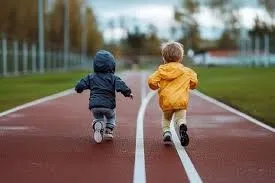
Physical development skills are often divided into three groups.
Gross motor skills
These involve the use of the whole body and include crawling, walking and running. These need space and pathways. Can you provide space for children to run, use their whole body movements? Is their opportunity for skipping, rolling and climbing?
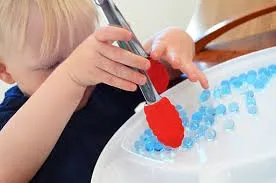
Fine motor skills
These involve using the small muscles in activities like pinching, grasping and handling. These need resources such as big tweezers, small loose parts. Any movement involving finger tips and small objects will support these skills. Developing these skills really help support mark making and letter formation, when children are ready to investigate early writing. Practitioners can prompt children by commenting about finger movement, or modelling.
Stability
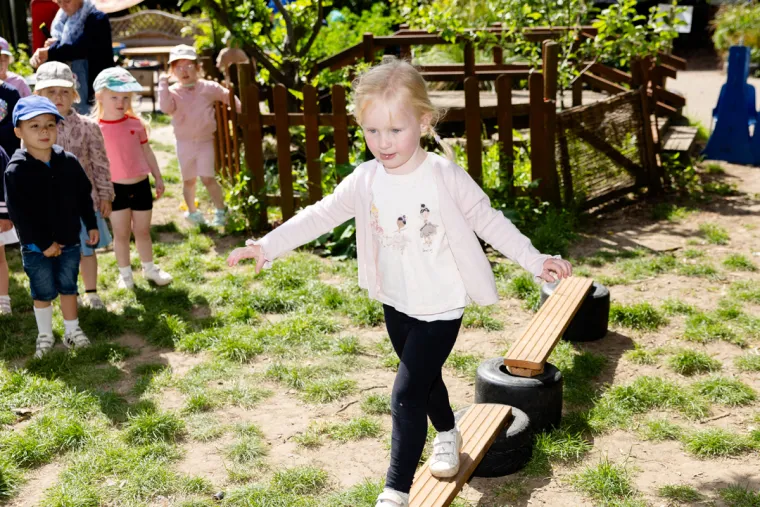
This helps the child develop skills to co-ordinate movement using their core strength. They can demonstrate this by sitting and balancing. These need resources and opportunity to balance such as walking along benches or seesaws. It also helps with spatial and positional awareness. All three can help with children making appropriate decisions based on their own physical capability. Practitioners can support a hesitant child by holding their hand or using more confident children to demonstrate.
Thinking about these three skills based areas, a first step to improvement could be to audit the indoor and outdoor environments, also the range of resources.
Key questions
Within the provision, are there any areas that could be reorganised to provide more space to develop gross motor skills?
Is there a range of equipment to encourage children to develop those core skills?
Have children access to a range of equipment to develop those fine motor skills?
Next steps
After improving the physical environment, research clearly identifies one of the key factors is in the skills used by the practitioners. This is to ensure children not only have access to resources and equipment but that they feel motivated to use it and enjoy physical activity.
What can the practitioner do to support this?
- Be enthusiastic and encourage children to take part in activities that they may usually avoid. Think of those children who avoid certain activities and encourage them to try something out of their comfort zone.
- Take part! When you can, join in and model activities. Show the children what it looks like. Children love it when an adult is an enthusiastic member of an activity.
- Teach the skills needed. Give clear verbal and physical prompts to guide and support.
- Break down movements into easily achieved chunks to help with remembering sequences. This is especially useful for dance or yoga based activities.
- Provide opportunities for children to practice independently after gaining the skills.
The overview- what does the evidence say?
- The more effective physical developmental approaches may be more effective when:
- Practitioners vary the difficulty of the tasks. Have a rotation of activities where possible.
- Practitioners interact by giving feedback to the children.
- Where possible, provide instruction with active play. See that ‘teachable moment’!
- Provide opportunities for the children three or more times a week, over several months.
Key takeaways
- Practitioners can implement approaches to support young children’s physical development.
- Environments and resources can be tailored to support the development of three key areas of skills.
- Practitioner interaction can further support the development of these skills.
Want to know more?
Further information linked to this blog can be found:
https://educationendowmentfoundation.org.uk/early-years/evidence-store/physical-development
https://educationendowmentfoundation.org.uk/early-years/toolkit/physical-development-approaches