

In July 2023, the pioneering Pen Green Centre in Corby, Northamptonshire, celebrated its fortieth year of responsively and innovatively supporting children and families, through collaboration with and celebration of the local community. In this case study Emma Hewitt, a Senior Education Tutor/Researcher at the accompanying Pen Green Research Base, explores how parents and practitioners across the centre confidently and consistently utilise schema theory to support young children’s developing speech, language and communication.

Schema theory in practice
The team at Pen Green have been studying young children’s schemas since the early nineties, initially meeting regularly with Chris Athey to think about individual children’s development and learning.
Since then, and as their understanding of schemas deepened, schema theory has become a ‘key concept’ within the Pen Green curriculum, ‘Frameworks for Thinking’. Practitioners share their understanding with parents across the centre and utilise schema theory as an alternative lens through which to consider young children’s experiences and support them in their most formative years.
I will use the following case study, of ‘Robert’, to illustrate a key finding from my research within the Pen Green Centre, which explored the relationship between schema theory and language development.
What I noticed in my observations of four young children was that children’s action schema seemed to reflect their emerging and developing thoughts about the world around them, including some complex concepts such as understanding ‘here and gone’. These children appeared to be developing their thinking by repeatedly engaging in these actions and the language, provided by those around them, offered a socially constructed method of labelling these externalised thoughts. Hollich et al (2003) refer to this process as ‘word-to-world mapping’ as I explored previously in my blog.
Robert (twenty-six months old):
Robert attends Pen Green three days a week, in a birth to three space ‘The Couthie’. Sue, his Family Worker, provides for his strong interest in water play. Robert became a big brother to Julian eight months ago and Jane, his mother, is pleased that their relationship has positively developed more recently.
During my observations Robert demonstrated his keen interest in water play, he spent time filling different sized containers either from the tap or by submerging them in water. I was interested in the fact that he never seemed to fill the containers to the very top and, often, after filling them, he would pour the contents out immediately and start refilling them saying “more water”.
I wondered if this was a comment he had heard previously and accommodated into his own vocabulary; on occasion I noticed practitioners playfully asking, ‘not more water Robert?’ as he returned to the tap. I have subsequently also recognised this as a demonstration of how children value the process of learning (filling the containers) over the product (a filled container). Schematically Robert seemed to be interested in containing and, also, scattering the water – on one occasion he sprayed water from his mouth quite spectacularly!
During one observation Robert spent time selecting all the smaller sea creatures from small world box, discarding larger or non-sea creatures. He contained these creatures in a plastic jar and then used the tap to add water to the same container. Seemingly realising there was still space left in the jar, he then returned to add more small sea creatures.
Robert used very little language during this sequence of events – he seemed truly engaged, in a personal state of ‘flow’(Csikszentmihalyi 1990).
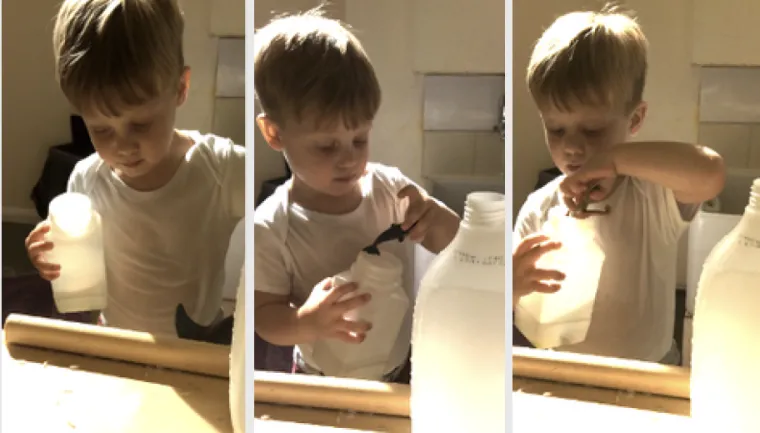
When I met with Robert’s mother, Jane and his Family Worker, Sue I shared my thoughts about the container of sea creatures, which reminded me of the proverb about a jar which once filled with rocks looks ‘full’, until you add pebbles, which ‘fit in’ around the rocks and make it ‘full’ again, until you add sand which also ‘fits in’ around the stones and makes it ‘full ‘again, until you add water which ‘fits in’ still. Likened this to Robert’s understanding of the emotional ‘space’ that is available for him, now that there is a little brother to ‘fit’ alongside.
Jane and Sue both agreed this was an interesting idea. Jane then supported this by saying that Robert is very interested in (changing) relationships at present and refers to a family friend as “my Hayley” [sic], instructing her: “Julian down” when she holds his younger brother. I wondered if, emotionally, this was about Robert re-creating a space for himself to ‘fit’ into, thinking about things that are the same and different – both to each other and from before. Robert further demonstrated his interest in sorting and classifying objects as he built a tower using only the same sized blocks and paired them according to their colour.
During this observation he ignored my suggestion to include smaller, flatter blocks in the same tower – perhaps, because they were different, like the non-sea creatures, and therefore they did not ‘fit’ his original thoughts?
This led me to think about Piaget’s (1962) notions of assimilation and accommodation; children either exercising existing schemas or amending them to make sense of the world around them. Similarly, during a later observation, Robert had sorted 2Dshapes into groups of squares, triangles and pentagons – the latter of which he referred to as “a circle”. During this activity Sue introduced the word ‘pentagon’, counting the five sides of the shape for Robert.
On this occasion however Robert appeared not to have the necessary conceptual understanding and therefore did not accommodate and begin using the new vocabulary introduced to him, despite the fact that it was relevant to the situation. Athey (2007) refers to adults offering conceptually focused language, which perhaps was not the case here.
Jane confirmed that, at home, Robert correctly recognises and names squares, triangles and circles; his existing conceptual understanding or, as Piaget (1962) referred to them, ‘schemes of thought’. By contrast, and building on his schematic play around containing, during later observations Robert had also started containing or enveloping in his mark making. In one observation he spent time drawing around my hand, his hand and his foot. As he engaged in this activity I repeatedly asked who and what he wanted to ‘draw round’ and as he did so he said to himself “round-and-round-and-round-and-round…”
Robert also verified my anecdotal thoughts about children using more complex language around subjects they are interested in as, during one observation, he was completely distracted from what he was doing by a practitioner reading a book about dinosaurs – he ran over and proudly stated “T-Rex” and then something resembling ‘Tyrannosaurus’.
Christakis sums this up when she describes the mystery she puzzled over as a preschool teacher ‘how could these children talk to me in such animated detail about important differences between crested-bullhead and Galapagos-bullhead sharks, yet have to be reminded multiple times per day… to pull up their pants after they left the bathroom?’ (2017: 227).
Robert’s case study supports the social-constructivist view that children learn language through conversation and experience – both of which we can support through noticing, recognising and responding to children’s schematic interests.
A criticism of social-constructivism is that children only learn what we, as adults, want them to know; instead Gross suggests that ‘adults who take their lead from the child have a more positive effect on language development than those trying to direct the child’ (2013: 17).
This is evident when Sue tries to introduce the word ‘pentagon’ to Robert; although it is relevant to the situation, it appears that he is not interested in the concept and therefore does not accommodate the new vocabulary.
A brief word about parents and the home learning environment.
Hopefully, Robert’s case study highlights a link between schema theory - as a method of identifying children’s conceptual concerns - and the role of practitioners, and parents, in offering appropriate and meaningful ‘word-to-world mapping’ (Hollich et al 2003).
In relation to schema theory this might mean offering language which relates to both content (the object/s children are playing with) and form (the action/s they are engaged in). Such language, which is matched to each child’s interests, is therefore more likely to be accommodated into young children’s ever-growing vocabulary bank. In practice, we should be conscious of the fact that for children acquiring more than one spoken language this process is potentially more complex but recognise that this is where parents can play their significant part. Schema theory also provides practitioners with an additional, practical approach with which to engage with parents regarding their children’s learning, and to encourage their involvement.
Gross recognises that ‘how parents interact with their children is a powerful predictor of the child’s language development and learning’ (2013: 136).
The Department for Education, together with the National Literacy Trust and Public Health England, agree, recognising that: ‘language skills are shaped and nurtured by the child’s home learning environment (HLE)’ (DfE 2018: 6). A copy of ‘Improving the Home Learning Environment: A Behaviour Change Approach’ can be found here.
In line with the Bercow reports (DCSF 2008; ICAN and RCSLT 2018), current policy states that: ‘the quality of the HLE is a key predictor of a child’s early language ability and future success; positive experiences can have lasting and life changing impacts’ (DfE 2018: 21). For this reason, I encourage early years practitioners to support parents in utilising schema theory, to help tune into children’s worlds, and therefore offer relevant ‘word-to-world mapping’ (Hollich et al 2003) to support all children’s speech, language and communication development and lay those important foundations for their future success.
Further reading:
My dissertation is published in full here:
Hewitt, E. (2021) ‘An exploration of the relationship between schema and language: four young child case studies’ Early Child Development and Care DOI: 10.1080/03004430.2021.1954628
…and, alongside many other interesting reflections about schema, here:
Arnold, C. (ed.) and The Pen Green Schema Group Schemas in the Early Years: Exploring Beneath the Surface Through Observation and Dialogue London: Routledge
For a full list of references please email: [email protected]