
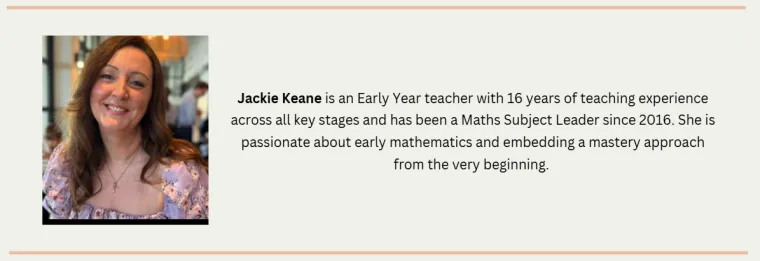
If you’d asked me a few years ago how I felt about maths, I’d have smiled politely and changed the subject.
I’m a nursery teacher, a maths lead, and someone who cares deeply about early learning. I felt, though, that maths belonged to reception classes, maths hub meetings and whiteboards. I didn’t connect it with two and three-year-olds building towers and pouring sand.
I’ll be honest, before I became a Maths Champion I thought I was doing quite a good job. I knew the children. I knew our provision. What more could there be to know about maths for two-year-olds?
It turns out quite a lot.
What maths are we doing here?
One of the first activities of the NDNA’s Maths Champions programme is to carry out staff confidence and environment audits (initial aspects of the programme). It was uncomfortable. I had to ask, ‘Why are we doing this?’ and ‘Where is the maths here?’
I’d spent years attending maths hub meetings that focused almost entirely on reception and beyond. Nursery rarely got a mention.
We educators in the early years have long known that birth to three matters, not just to pave the way for ‘proper’ maths, but for doing maths and understanding it.
I didn’t understand what I was doing
I came to see that while I believed in early maths, I didn’t fully understand it.
It was challenging to accept how we’d been approaching maths: it was common practice to sit with children and chant number names, count endlessly and laminate numbered leaves to staple to trees - we called this maths outdoors.
We were so embedded in such activities that we didn’t stop to reflect until the Maths Champions programme.
The audits opened our eyes.
Instead of forcing maths, we allow it to emerge
One of my main challenges was getting teaching assistants on board. It felt daunting, but we learned together, questioned together and gradually let go of practices that were not serving the children.
We looked carefully at our environment. The construction room. The home corner. The outdoor space. We constantly asked ‘where’s the maths’?
We stopped focusing on number names and started working on developing number sense. So, we introduced more open-ended resources such as dice, dominoes and collections of real objects.
Overall, we stopped forcing maths and began to recognise it in everyday activities.
Practice example
Two children were dragging logs across the mud kitchen. One announced that his log was “bigger”, as he struggled to move it. The other child had a shorter log and placed it next to his friend’s. They compared lengths, tested the weights and decided the big one was too heavy for one person to carry.
All I needed to do was notice, name what I saw and remain curious.
Outdoor maths is now about using logs to compare lengths. Steps are something to notice and count. The home corner is rich with lots of objects.
We are far less interested in counting for the sake of it. Our emphasis now is noticing and thinking.
Practice example
Before our new way of approaching Maths, Alfie counted everything, often inaccurately. He did it because he thought that’s what maths was about. Recently, one morning he picked up two dice, glanced at them and confidently said, “That’s five,” without counting a single dot. He smiled, quietly proud.
That moment told me a lot. Maths is about understanding.
Maths is part of our everyday practice
My confidence, and that of the other staff, has transformed more than I can say. We no longer see maths as a separate subject, but as part of everyday practice. We notice maths all around us and know a lot more about how to respond to children when they share their mathematical thinking.
Practice example
Sarah announced, “We need one more cup because there’s another friend.” Rather than praising her counting, I asked, “How do you know we need one more?” She paused, looked at the chairs, and replied, “Because there’s a space.”
Sarah demonstrated her understanding of counting - all I had to do was listen and extend.
If you’re not a maths person …
Are you reading this and thinking ‘it sounds great, but I’m not a maths person’? Well, I can wholeheartedly say that this programme is the one for you! Go for it and sign up here.
Before this strongly evidenced Maths Champions (EEF), I thought I knew what two-and three-year-olds needed. Now I realise that I didn’t at all.
I started the programme all prepared to give up on it. I finished it proudly calling myself a Maths Champion.
I haven’t laminated a leaf since.
Maths Champions is not about adding pressure and workload, but learning to look, reflect and make small but powerful changes.
To find out more about Maths Champions and sign up click here.