

Kia ora from Aotearoa, New Zealand. My name is Lorraine Sands and I have worked with the Educational Leadership professional learning team since 2001 in conjunction with my learning, teaching, and research colleagues at Greerton Early Learning Centre, a family-focused early years setting. This case study follows on from comments in a companion blog post. All our work is embedded in Te Whāriki: He whāriki mātauranga mō ngā mokopuna o Aotearoa, Early childhood curriculum (MOE, 1996, 2017) because we value the principles and aspirations of this holistic, relational, sociocultural curriculum.
My thoughts on the context of this learning journey…
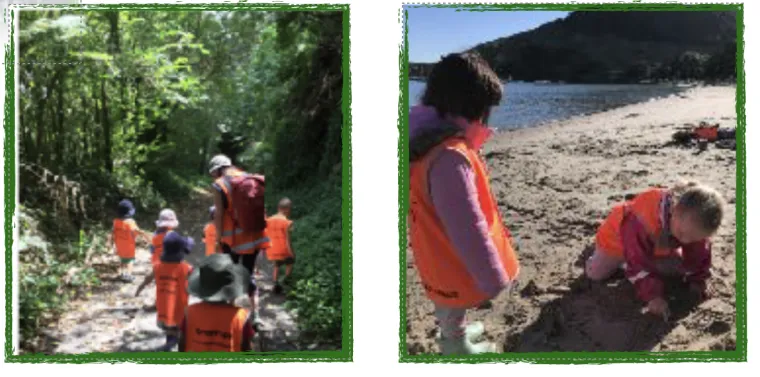
Meandering, it seems, creates space for thinking. Our children have had long experience with exploratory adventures together over the years and know that as something strikes their interest, we will all stop, engage with what someone considered interesting, and talk about it. As a newborn bird was found on the grass today, for example, children gathered and expressed their ideas about what had caused this tiny creature to die so tragically. We think that what is important here is that our children have as many opportunities as is fairly possible to express their thoughts and continue, therefore, to expand their thinking about their world.
Curiosity has an unpredictability component. It pushes boundaries, asks quirky questions and has ideas that spark theories that actively engage learning minds.Curiosity is deeply embedded in the conversations Te Ao Marama teams have together. It seems that we see things of interest both with our eyes and our hearts. What captures one person’s interest is then conveyed to others in ways that cause, often serendipitous curiosity, to flourish. Sometimes this is with a friend, and sometimes our whole creative team is involved. As kaiako, we want to nourish the emotional connection arising during these encounters within nature, for we think it is in the sharing of ideas that we come to realise that listening precedes speaking and that we all grow from hearing another’s perspective. These ideas underpin teacher thinking wherever we decide to venture on any given day.
Jumping the narrow stream might look narrow... but supreme courage and self-belief is required. community learning story
Learning for children is steeped in curious emotional and social energy. Leaning environments designed to nurture these energies enable children to imagine possibilities, even when learning is uncertain, long past the easy bits into practice and effort.
We were off to the stream, drawn by the thought that we could see the eels that lived there. We know from our past experience that plans are a moveable feast, and once an avenue has been explored, other opportunities present themselves. It was not surprising, then, that Team Tuesday considered jumping the stream a worthwhile challenge. However, this wasn't easy, and as children stood on the bank anticipating the jump, we could see and hear the risks being weighed.
As children watched the first successful jumps, the desire to fly through the air too was one part of the motivation; however, so too were the encouraging voices around them.“See, Sophie,” Isla said to her friend while pointing towards the stream, “You can jump to Tanya. You can do it!” As Sophie considered the challenge, she called to Tanya, “You will have to pull me up. I might slip.” Tanya gently responded, “If you slip, I will catch you, but you will need to do the jump yourself.” Isla again acknowledged Sophie’s concerns and said, “You can do it!” She followed these words with an encouraging pat on Sophie’s back. Other children were watching and listening. A resounding chorus of “You can do it! You can do it", erupted! Sophie paused, and then we heard the whisper of her self-talk: “I can do it; one, two, jump!” A leap in the air, a hat falling off, an ecstatic laugh, and the feelings o success were written all over Sophie’s face. In a very big, euphoric voice, from the other side of the bank, Sophie exclaimed, "I did it!”
The feelings of being unsure were mirrored elsewhere too. Sophia took a long time to make her decision. Likewise, other children were less sure about their ability to pull off this big challenge; however, with their friends’ successes and being watchful of the children’s respective techniques, the courage to leap into the
air happened for each of them.
What learning did I notice today?
There was so much, and this is why teachers love coming with our teams of children each week. Particularly for me today, I thought of the dispositions of courage and generosity.
At Greerton ELC, we never shy away from discussing 'struggle' because to stretch learning, the challenge has to be a little ahead of ability. Not so much that children are frustrated but not too little that the feat is no challenge at all. Anything worth doing does require characteristics loaded with self-belief, determination, perseverance, a solution-focused mindset, and all manner of dispositions that we acquire from our experiences. This is one of the reasons, among many, that we love going into the natural world because challenges arise from the environment that excite children’s curiosity to explore further. We are in a supportive team of learners, teachers and researchers, and we help each other to be our very best learning selves. Is this easy? No, but that’s the point! Is it satisfying? We did hear Sophie say, “This is the best day ever!”
How might we all keep stretching our learning?
We keep coming back to our favourite spaces because this gives us opportunities to re-experience challenges and stretch our abilities. We love that the learning feeling of “I can do it” and equally empathic learning feelings underlying comments like, “You can do it,” indicate to us that the experiences in nature are ones that grow learner dispositions. These characteristics are transferable to other times and places. The jump back was more difficult because it was uphill, and this time the feeling of “I can do it” triumphed. There were no thoughts that help was needed, and success abounded.
“Ruby, I think you are a thoughtful contributor to our learning community.”
Today, during our quest to find some tuna at the farm, in response to trying to figure out what the odd-looking stains across parts of the stream were, Ruby, you made these contributions: “Maybe, maybe, maybe, maybe, the oil just came in." I offered the smallest of hints, alluding to oil from cars, and Ruby, you rethought your idea and said, “It goes down the gutter into the pond.”
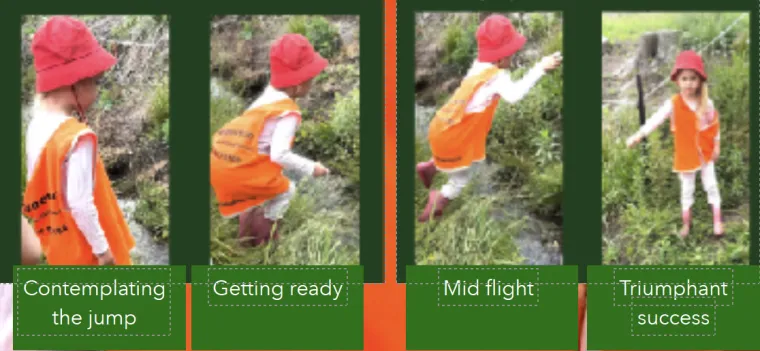
A bit later, after feeding the eels, our children mooted the idea of jumping across the stream to the other bank. Ruby, you were one of the first to successfully navigate the challenge, and when asked if you could offer some advice to others who wanted to jump but were finding the courage to do so somewhat difficult, you said, “I jumped in the close bit" and pointed the way...”I used my hands as well.
Back at our hut, when conversations were focused on how we could make swinging on the flying fox fair for everyone, you said, “Maybe ten swings?”
It seemed to me that all through this day within nature, whether it was a scientific problem like the oil spill in the waterway, a challenging physical feat to be overcome like jumping across the stream, or an empathy-focused dilemma, you set your mind to solving the problem. The oil spill was about a wider understanding of how science is embedded in the natural world. The stream challenge was about logical-mathematical estimation and the fairness issue between friends—a moral question of justice.
No matter which varied focus was at the fore, you had the emotional and intellectual courage to offer a solution, yet you were also able to hear another perspective and adjust your thinking. This is about developing a creative brain that is growth-mindset-focused. This means you see possibilities and act on them—and just like the whakataukī above, in seeking learning opportunities as you did today, you are nurturing your wellbeing and expanding your understanding of who you are as a learner.
How might we all nurture your learning further?
I know, too, from other encounters with you and from reading learning stories written by other teachers that there is also a whole other story-telling, playful, creative aspect to the way you engage with others. It seems to us all that your learning keeps stretching its own boundaries when you are in curiosity-filled environments and around people who value conversational learning encounters.