

How does loose part play support children’s learning?
(Click on the PDF at the bottom of the page for our handy printable resource card.)
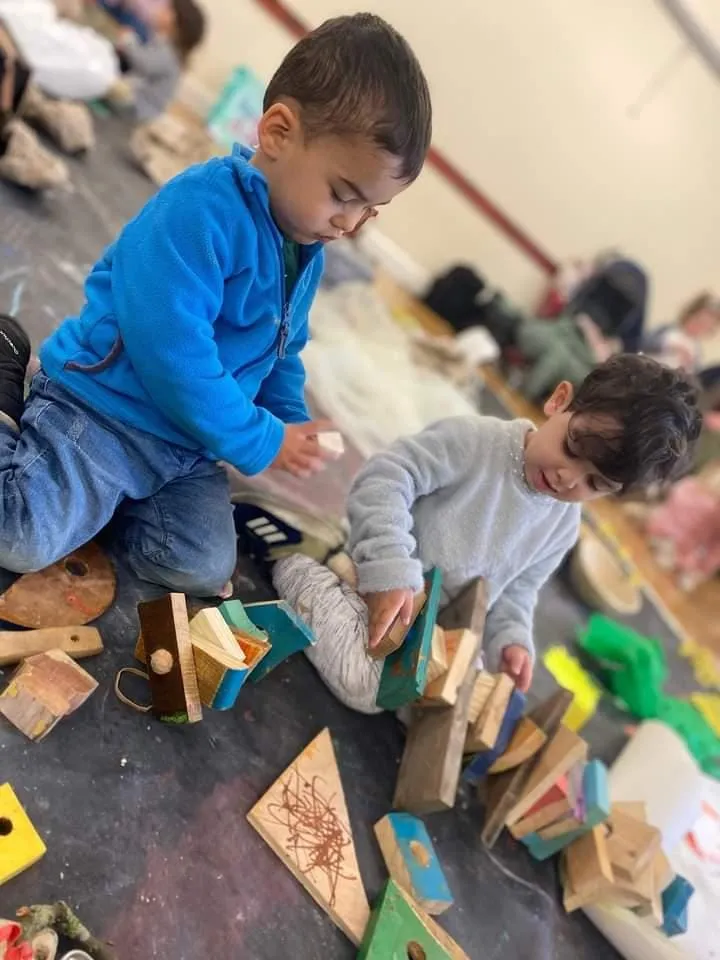
Most areas of learning can be supported through loose parts play.
Personal, Social and Emotional Development
- When playing with loose parts, children can discuss their ideas and listen to the ideas of others. There is strong evidence that shows allowing children to play collaboratively helps develop relationship skills.
Communication and Language
- Children can also extend their vocabulary as they are introduced to new words during their play. There is strong evidence that teaching and modelling vocabulary can have a positive effect on oral language skills.
Mathematical Development
- Loose parts provide endless opportunities to investigate size, shape, classifying and to introduce mathematical vocabulary. Research suggests that children who have good mathematical language do better in maths.
For more information on how to use evidence informed approaches to improve outcomes for children visit the EEF evidence store
Early Years Evidence Store | EEF (educationendowmentfoundation.org.uk)
Downloads
The Evidence Store ~ Loose Parts Play pdf
Loose Parts Website.pdf
(195.84 KB)
The Evidence Store ~ Loose Parts Play