
Delivered and reported on by Jannice Simpson (East of England Early Years Stronger Practice Hub) and Jo Fowler (Retired Early Years Specialist Educational Psychologist)
What we did and who was involved
The evidence-based VERP training and coaching programme, based on the principles of Video Interaction Guidance (VIG), focuses on enhancing the quality of practitioners’ face to face verbal and non-verbal interactions, through the development of effective approaches and practices that can sensitively support and extend children’s language and communication skills and foster their positive well-being. This was considered likely to be an effective intervention to help redress the negative effects of the Covid-19 pandemic on young children, through enhancing staff skills and confidence.
For this professional development project, we initially offered a range of taster and more in-depth introductory sessions focused on the essential principles behind quality interactions, as well as the Video Enhanced Reflective Practice (VERP) model of staff development. The online webinar taster sessions proved more popular than the face-to-face introductory workshops and enabled us to reach a wider audience across the EYSPH reach area. Three EY settings opted for a more in-depth PD programme, and two of these took up our offer of a full VERP supervised practice programme. Between June 2024 and July 2025, we delivered 6-month long VERP projects to all staff members of both a PVI Day Nursery and a school EYFS team. The participants ranged from young early years apprentices to highly experienced/qualified practitioners – including the managers and teachers.
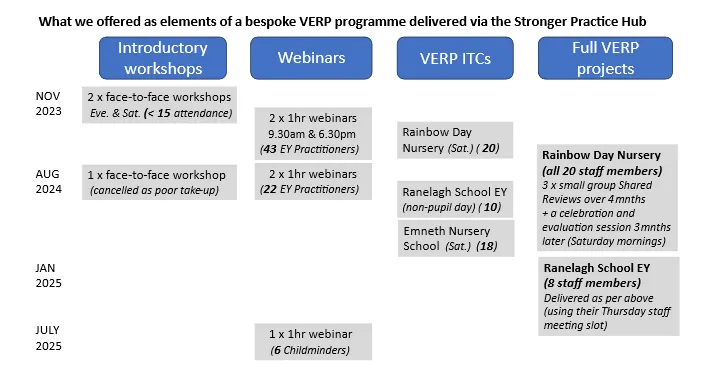
Rainbow Day Nursery is a North Suffolk PVI setting for infants from 1 – 4yrs; Ipswich-based Ranelagh Primary School EYFS department includes a Nursery and Reception class; and Emneth is a stand-alone Local Authority Nursery School on the Norfolk/Cambridgeshire border.
What strategies/evidence/approaches were used?
Identified need and rationale for this intervention
The NCB’s ‘Vision for Recovery: Early Years Briefing’ paper (2020) highlighted the impact of the Covid-19 pandemic on the well-being and development of young children – particularly those from disadvantaged/less affluent homes and those not able to access regular Early Years provision. The most significant attainment gaps were identified in the areas of Communication & Language; and Personal, Social & Emotional Development. The provision of rich language experiences, and consistent positive and high-quality interactions from attentive care-givers, can help to close these gaps in the Early Years. Hence it was felt that VERP’s focus on helping practitioners to explore and further develop their attuned interactions with children could potentially make a significant contribution within the local Covid-19 EY recovery programme.
VERP outcomes align well with the aims of the DfE EY recovery programme, and support overall stronger practice. This strengths-based short-term intervention aims to support the development of key communication skills and quality relationships, through guided self-reflection. The ‘EYFS framework’ stresses the importance of supportive relationships, and the quality of interactions.
The DfE ‘Development Matters’ guidance promotes effective high quality sensitive care, tailored to individual needs, and the DfE ‘Help for EY Providers’ website states that ‘good interactions’ (both verbal and non-verbal) between adults and children make a big difference to how well communication and language skills develop. VERP outcomes also align with one of the aims of the current EYPDP to build on practitioners’ skills and knowledge to improve the quality of adult-child interactions. If practitioners can be more aware of their strengths, in relation to their own interaction style and habits, the better they will be able to respond to the needs of young children. High-quality interactions depend on positive relationships with tuned-in adults.
The evidence and approaches used
The VERP approach is a specific application of Video Interaction Guidance (VIG), focused on professional development. The aim of this case study was to enhance the quality of adult-child interactions through the delivery of bespoke interventions based on the principles and practices of VIG. There is a wealth of evidence of the effectiveness of VIG work with parents, and it has been specifically recommended by NICE as one of the evidence-based interventions ‘to support the social and emotional wellbeing of children in their early years’ (NICE PH40, 2012), promote secure attachment in children on the edge of care (NICE NG26, 2015), and for children with Autism (NICE CG170, 2013 updated 2021).
The ‘Principles of Attuned Interactions and Guidance (PAIG)’, that are a core feature of any VERP course, are consistent with the recommendations from the Education Endowment Foundation - in terms of the sorts of approaches and practices that practitioners are encouraged to use in their everyday interactions with young children. The EEF stresses the importance of high-quality adult-child interactions within early years settings.
In their Preparing for Literacy guidance report it is number 1 on the list of evidence-informed recommendations underpinning high-quality Early Years Provision. They also highlight the distinction between talking with children, and simply talking to children. VERP can help practitioners become better ‘conversation partners’, through the use of video reflection and guided micro-analysis of their positive interactions with children.
The VERP approach is likely to have a positive impact on at least two of the themes included within the EEF Early Years Evidence Store (Communication & Language; and Personal, Social & Emotional Development). More specifically, the expected impact would be on Teaching and Modelling Social Communication Skills, and Teaching through Collaborative Talk (C & L), and also Teaching and Modelling Social Communication, and Teaching Relationship Skills (PSED). The Attunement Principles (PAIG) that form the basis of VERP link closely with the recommended practices, and support the development of the practitioner’s role as an ‘attuned and responsive’ adult, with the skills to ‘listen to children and encourage sustained back-and-forth conversations’.
The EEF Early Years Evidence Store also includes guidance on ‘Improving early education through high-quality interactions’ (Sept 2025). The ShREC stepped approach is introduced, which offers a simple set of strategies to promote shared attention and back-and-forth conversation. The approach starts with shared attention (Sh), moving on to the practitioner offering non-verbal and verbal responses to the child’s initiatives (R). The third step is expanding the interaction by repeating and building on the child’s response (E), leading to the final step of extended back-and-forth conversation (C).
The adult behaviours included in VIG/VERP’s Principles of Attuned Interactions and Guidance dovetail nicely into this approach (a copy of the PAIG list can be found on page 5). VERP participants are supported to spot and reflect on a process that begins with being attentive to the child, which then can develop into an attuned interaction through encouraging and receiving the child’s initiatives. Once the adult is tuned-in to the child’s needs, they can start to guide/scaffold the child’s thinking and ultimately engage in an extended interaction/deepened discussion.
The strategies and methods used for the VERP projects
For the two settings engaged in the full VERP projects, the initial training was followed up by three months of supervised practice, where small groups of practitioners got together with a VERP supervisor on a monthly basis for 1.5hrs, to reflect on short video clips of each other’s ‘better than usual’ interactions with one or more young children. This shared reflection on moments of positive communication enables practitioners to observe strengths not noticed before, and helps focus on building the skills that lead to attuned interactions with young children – including those with a range of learning, social or emotional needs. The group VERP supervisions were delivered by Jannice and Jo – who are both highly experienced supervisors in Video Interaction Guidance (VIG) and VERP and have delivered a number of successful EY VERP projects previously.
The VERP approach is very much led by the participants, and tailored to individual wishes and needs. They establish their own initial personal goals relating to their practice (see examples below), and they take and select their own video clips to bring to each group shared review. They are also active in the assessment of their own skill levels pre- and post- project and of their progress towards their goal(s).
Some examples of participants’ self-constructed pre-VERP individual goals
“To extend children’s ideas without asking too many questions”
“To have more confidence in my practice”
“To see if I’m engaging all the children (in a group), and extending their knowledge”
“To listen more - not jump into a child’s conversation so quickly”
“To sustain interactions by being playful, and contributing equally in play”
“To gain confidence in judging when to join in - not taking over”
“To support and help expand child A’s peer group interactions”
“To be the best I can be at turn-taking and modelling language”
The positive outcomes for the EY practitioners were carefully evaluated throughout, using both quantitative and qualitative measures (see below), and the longer-term impact was explored via a final recorded evaluation/celebration session held three months after the period of supervised practice had ended. As VERP is a nationally recognised training, regulated by AVIGuk, certificates were awarded to all participants.
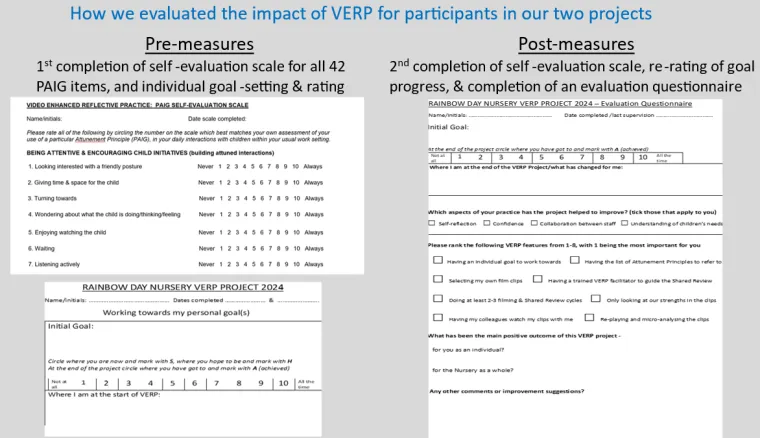
The 42 PAIG items included in the self-evaluation scale are the behavioural descriptors that make up the ‘Principles of Attuned Interactions and Guidance’ that have been developed to support the work of the Association of Video Interaction Guidance (AVIGuk). The items are associated with 6 interactional domains: - Being Attentive; Encouraging Initiatives; Receiving Initiatives; Developing Attuned Interactions; Guiding; and Deepening Discussion (a copy of the full list of VIG Attunement Principles can be found below).
Principles of Attuned Interactions and Guidance
Being Attentive
- Looking interested with friendly posture
- Giving time and space for other
- Turning towards
- Wondering about what they are doing, thinking or feeling
- Enjoying watching the other
Encouraging Initiatives
- Waiting
- Listening actively
- Showing emotional warmth through intonation
- Using friendly and/or playful intonation as appropriate
- Naming what the child is doing, might be thinking or feeling
- Naming what you are doing, thinking or feeling
- Looking for initiatives
Receiving Initiatives
- Showing you have heard, noticed the other’s initiative
- Receiving with body language
- Being friendly and/or playful as appropriate
- Returning eye-contact, smiling, nodding in response
- Receiving what the other is saying or doing with words
- Repeating/using the other’s words or phrases
Developing Attuned Interactions
- Receiving and then responding
- checking the other is understanding you
- Waiting attentively for your turn
- Having fun
- Giving a second (and further) turn on same topic
- Giving and taking short turns
- Contributing to interaction/activity equally
- Co-operating - helping each other
Guiding
- Scaffolding
- Saying ‘non’ in the ‘yes’ cycle (attuned limit setting)
- Extending, building on the other’s response
- Judging the amount of support required and adjusting
- Giving information when needed
- Providing help when needed
- Offering choices that the other can understand
- Making suggestions that the other can follow
Deepening Discussion
- Supporting goal-setting
- Sharing viewpoints
- Collaborative discussion and problem-solving
- Naming difference of opinion
- Investigating the intentions behind words
- Naming contradictions/conflicts (real or potential)
- Reaching new shared understandings
- Managing conflict (back to being attentive and receiving initiatives with the aim of restoring attuned interactions)
Copyright Kennedy, H (2011) Table 1 Chapter 1 in Kennedy, H., Landor, M. & Todd, L. Video Interaction Guidance: relationships-based intervention to promote attunement, empathy and well-being London: JKP
What outcomes were achieved?
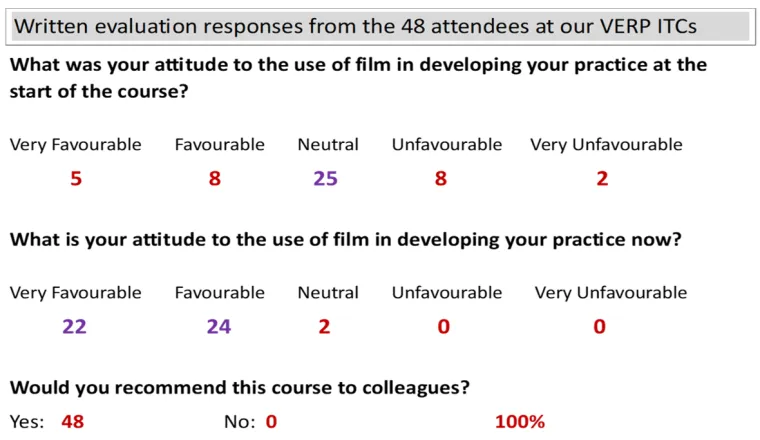
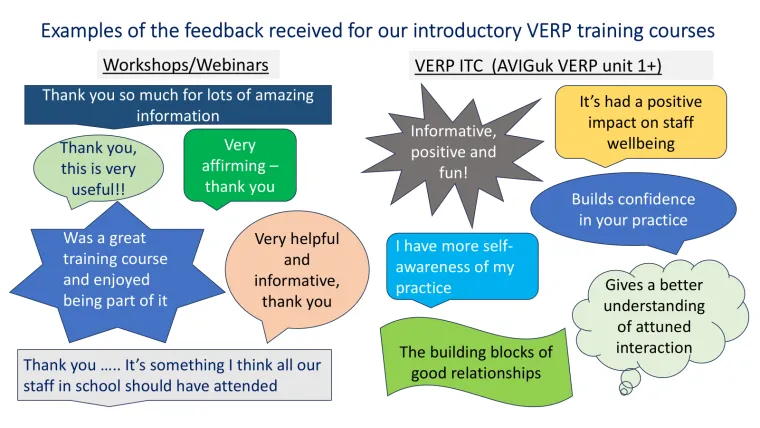
We have been able to train a total of 133 early years practitioners across the East of England in the VIG ‘Principles of Attuned Interactions and Guidance’ and introduce them to the value of using video to enhance their practice. The feedback from participants on our initial workshops, webinars and full training courses was extremely positive (see example quotes in a later section). For those receiving the full VERP Initial Training Course (VERP ITC), 100% confirmed that they would recommend this training to colleagues, and there was a clear positive shift in their attitude to the use of film in developing their practice. This outcome was very pleasing because reflecting on, and sharing, video clips of good practice can really help to improve skills.
Our evaluation of the outcomes from the two full VERP projects yielded some rich quantitative and qualitative data. In terms of progress towards participants’ personal goals, in relation to their interactions with the children in their setting, we saw an average increase in self-ratings of 3.2 across the two settings (median 3, spread 1-5 ratings points). As expected, a smaller degree of self-reported progress was seen for those already rating themselves above 5 prior to the period of supervised practice.
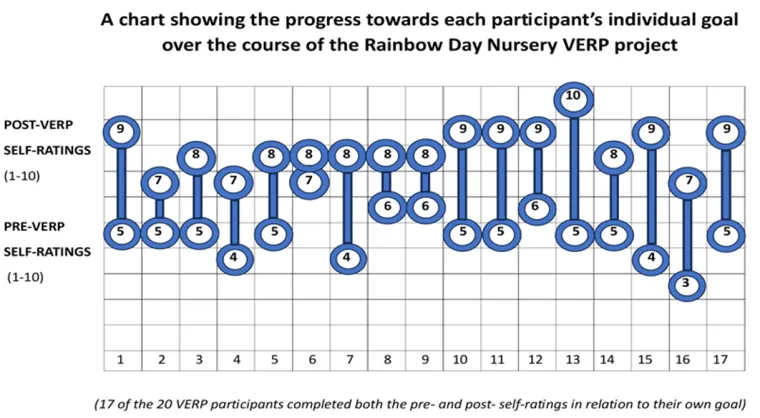
Participants’ self-ratings on the 42 Attunement Principles (PAIG) showed an average percentage increase of 19.7% overall (spread -0.3% – 48.6%). The most improved area was Encouraging Initiatives (22.1%), with Deepening Discussion a close second (20.0%). This was a very pleasing outcome, as common goals were to try to ‘wait and listen more’ (instead of dominating the interaction with questions), and also to sustain more back-and-forth dialogue.
The participants of a previous early years VERP study in 2021, by Anita Soni in Birmingham (see Appendix for reference), reported four main positive outcomes for their practice: -
- increased self-reflection,
- confidence,
- collaboration
- understanding.
For our two VERP projects we therefore explored which of these aspects of practice were seen as relevant for our participants. Improvements in self-reflection and confidence were noted by almost all participants across both settings, and well over half felt that they had a better understanding of children’s needs.
Our evaluation questionnaire also explored the relative importance of 8 essential features of VERP for each of our participants. Three features were ranked in the top four by the staff from both settings:-
- Only looking at our strengths in the clips
- Having a trained VERP facilitator to guide the Shared Review
- Having the list of Attunement Principles to refer to
Practitioners from the Day Nursery also ranked ‘Having an individual goal to work towards’ very highly, whilst the school EYFS team strongly valued ‘Having my colleagues watch my clips with me’.
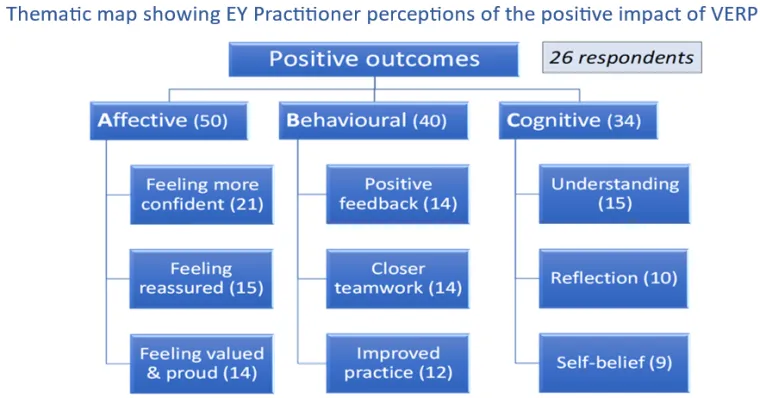
A Thematic Analysis was applied to participants’ written responses to the two open questions in the evaluation questionnaire:
- What has been the main positive outcome of this VERP project - for you as an individual?
- For the EY team as a whole?
- Any other comments?
The thematic map below shows that the experience of a VERP intervention appears to have its strongest impact on practitioners’ feelings about themselves and their practice – especially their confidence in interacting with children. They also reported an increased understanding of children’s needs, and of their own particular interaction habits. Nearly half felt that their actual practice had improved in terms of their quality of everyday interactions, and the initial training course, (plus the list of Attunement Principles), offered them specific skills to reflect upon, and a common language with which to praise each other.
What impact did it have? - The “So What”
We submitted our bid for VERP to be included as part of the offer from the EY Stronger Practice Hub because, although much of the current guidance focuses on the importance of quality interactions with young children (see examples below), Early Years Practitioners are often unclear about what ‘high-quality interactions’ actually look like in practice. VERP offers an extended period of training and supervision in the Attunement Principles that underpin quality interactions. These positive experiences are key to a young child’s cognitive, social and emotional development. We were reassured that participants acquired some new learning that would impact practice, but the most powerful outcome from the VERP projects was the increase in self-awareness; confidence/pride in their interaction skills; and the positivity generated.
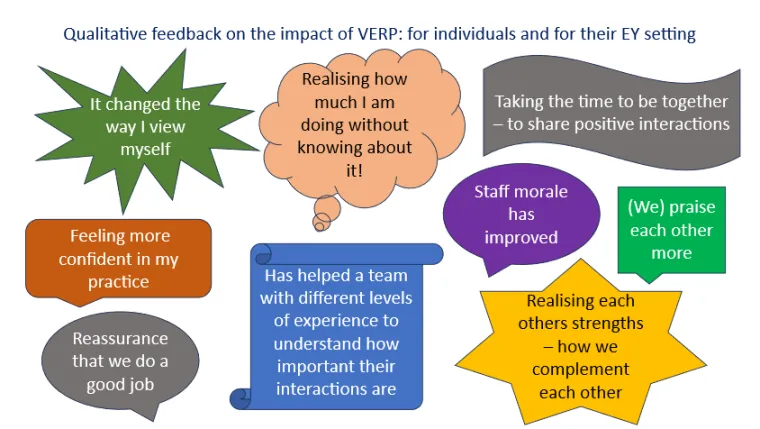
Three months after the period of monthly VERP supervisions had ended, we returned to both settings to explore the longer-term outcomes of the projects. Participants reported that the training was very different from other courses they had attended. It had a strong positive impact on them emotionally, as well as increasing their understanding of what makes a ‘good’ interaction. They also felt personally supported in improving their practice, through building on the strengths they already had, and being given the opportunity to learn from their colleagues.
Having the team leaders (managers and teachers) taking part was also seen as important, as everyone was on a level playing field and felt empowered by having their skills and strengths acknowledged by others.
In conclusion, the experience of VERP training and a short period of supervised practice can have a lasting positive impact on practitioners’ morale, skills, practice, self-perception, and team culture. Managers also indicated a desire to factor regular video reflections of practice into their teaching and learning evaluations.
Because VERP micro-analyses the everyday practice of interacting with children, the approach can be very helpful in supporting practitioners to recognise high-quality interactions, and to understand the fundamental development process embodied by both VERP and ShREC.
The Main Take-aways from our VERP Projects
- VERP is universally accessible - the progress and reflections were largely similar from young apprentices to highly experienced/qualified staff.
- Even just from the introductory VERP Training can have a strong impact including on practitioners’ attitude towards the use of video.
- Participants reported progress relating to their individual goals and skills.
- The PAIG list offered a common language to use when praising each other.
- The strongest impact was on participants’ feelings (about self and practice)
- There was a reported shift in focus to an appreciation of their strengths and positive relationships, rather than on areas of improvement.
- There was evidence of a lasting impact of VERP, beyond the project, including an appreciation of an experience that enhanced staff wellbeing.
Quotes and resources on the importance of high-quality interactions in the Early Years
- “Stable, supportive environments and positive interactions during this period play a unique role in shaping a child’s brain.” National Children’s Bureau Covid-19 resources: A vision for recovery - Early Years recovery briefing, 2020, https://www.ncb.org.uk
- “Children’s back-and-forth interactions from an early age form the foundations for language and cognitive development” DfE: Development Matters, EYFS non-statutory guidance 2023, https://www.gov.uk/government/publications
- “Research shows that good interactions between adults and children make a big difference to how well communication and language skills develop” DfE: ‘Help for EY Providers’ website - https://help-for-early-years-providers.education.gov.uk
- “High-quality interactions are a guiding principle for work in the early years” EEF: Improving early education through high-quality interactions, 01/09/2025 https://educationendowmentfoundation.org.uk
- “Children’s behaviour and learning hinge on high-quality interactions with adults”. Nursery World: ‘An essential guide to…interactions’, 05/08/2019. https://www.nurseryworld.co.uk
- “Nurturing, responsive interactions are vital for healthy neural development.” EEF: Fliss James’ blog, 02/02/2022, ‘Supporting high-quality interactions in the early years’. https://educationendowmentfoundation.org.uk/about-us/our-people/241678
- “Early interactions are crucial to children’s language development. The quality and quantity of interactions matter.” Best Start in Life: A research review for early years - Part 2: ‘The 3 prime areas of learning’, 08/10/2024, https://www.gov.uk/government/publications
Appendix: Relevant findings from some earlier VERP research projects
The 2015 publication ‘Video Enhanced Reflective Practice: Professional Development through Attuned Interactions’ edited by Kennedy, Landor & Todd (publ. Jessica Kingsley) shares some related research delivering VERP projects for staff in Nursery/Infant settings.
Ferguson (Ch.21) looked at the impact of a combined VERP & Active Literacy programme on the actual behaviours/practice of 12 Nursery staff, and found that post-VERP there was an increase in the number of child-initiated back-and-forth conversations and in the use of open challenging questions, with a corresponding decrease in the time spent giving information and instructions.
Hayes, Browne and Tod (Ch.16) looked instead at individual and systemic changes following a VERP project involving 10 infant school staff. ‘It seemed to create conditions that allowed individuals to think about themselves differently’, Participants felt more consciously competent in their skills in interacting with children. VERP also encourage the formation of collaborative group - that offered peer support, and seemed to result in a levelling of hierarchies.
Jarvis & Lyon (Ch.2) studied the experience and impact of VERP for 5 EYFS staff in a school. The participants particularly appreciated the ‘time for reflection’ and the modelling provided by the VERP guider; the strengths-based approach; having personal goals to work towards; and the positive use of video. Post-VERP, all staff reported that ‘the emphasis of their practice had shifted, with much more awareness of their own interactions and the effect of these on the children’.
Soni, A (2021), Empowering collective reflection: realistic evaluation of video enhanced reflective practice (VERP) in an early childhood setting in England. Professional Development in Education. Soni delivered a VERP intervention to 5 members of staff within an EY setting, and explored the relevant significance of 8 key aspects/mechanisms of VERP that participants felt were essential for positive outcomes. She also identified the 4 main reported outcomes through the Thematic Analysis of their verbal feedback (reflection; confidence; collaboration; and understanding of children)