

The Successful Management of Change; How can research help us?
A blog by Eileen Allpress. Research Lead for the East of England Stronger Practice Hub.
Eileen Allpress is the Research Lead for the East of England Stronger Practice Hub with over 30 years’ experience in education. She has been a Headteacher, SENDCo and has facilitated a range of Professional Development sessions.
Within education having to deal with implementation of change is something all practitioners have to deal with on an increasingly regular basis. At, times this culture of change can prove overwhelming, confusing and make dealing with it an added stress in an already difficult landscape.
Professor Becky Francis (Chief Executive, Education Endowment Foundation (EEF)) states,
“Schools are complex environments and leaders and teachers face competing pressures on their time, resources and head space.”
Although this quote is linked with schools and teachers, I think you will agree this pressure of implementation of change is equally relevant to all education settings and practitioners.
It is therefore important to recognise that this is an area which can cause stress to leaders in all ages and stages of education. There are supporting evidence-based resources that will give support and guidance to the implementation of change.
One of the approaches available to help support the implementation of change is use a change model. There are a range available and it can be useful to spend time finding the one which will work well within the context of your setting.
John Kotter’s 8 step Change Model was first introduced in 1995, in the Harvard Business Review. It has been used in a wide range of different settings to lead change.
Kotter argues that simply creating a compelling vision and securing buy-in isn’t enough. For change to take root, employees at all levels need the resources, authority, and support to take ownership and make it happen.
His model has 8 stages:
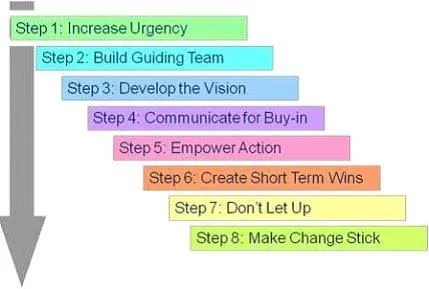
Step 1- Create Urgency
Step 2- Form a Powerful Coalition
Step 3- Create a vision for Change
Step 4-Communicate the vision
Step 5-Remove Obstacles
Step 6- Create Short term wins
Step 7-Build on the Change
Step 8- Anchor the Changes in the organisation’s culture.
The researcher Elizabeth Kubler-Ross focused her work on the emotional responses to change. Her field was within the study of people approaching death. She produced the Kubler- Ross change cycle or as it is sometimes known the ‘grief cycle’. This cycle has been used within the management of change as it was impactful for leaders to empathise with employees when facing change or disruption.
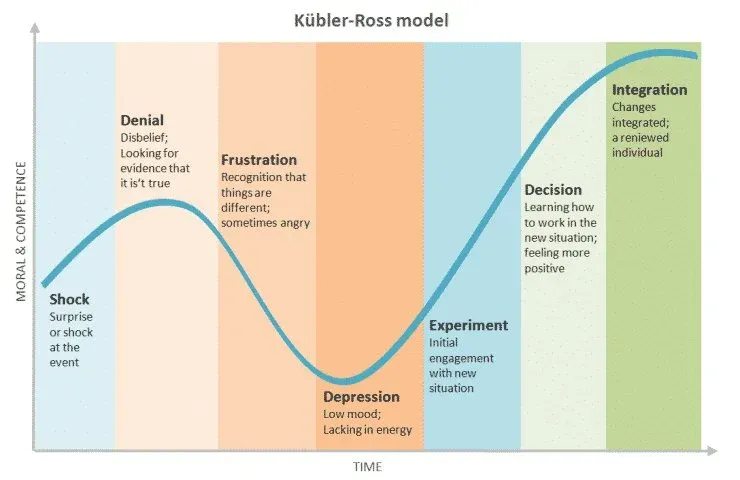
Stages 1,2 and 3 are when leaders may expect practitioners to be angry at the change, display confusion and possibly blame external or internal causes for the change. Kubler- Ross advises leaders to give time to these 3 stages and allow practitioners to vent and communicate their feelings in an appropriate way.
When they are ready you can then continue to stages 4,5 and 6. Having an awareness of the emotional responses can be a very useful managerial tool in the management of change.
In 2018 the EEF produced ‘A School’s Guide to Implementation- Guidance Report’. This has recently been updated and the new report has built on and fortifies the previous version.
This report adds to the body of evidence on effective implementation and sharing information of a new review of the information.
The evidence is clear that implementation requires ongoing learning and improvement.
Also we need to ‘ do fewer things, better’.
There are 3 key recommendations within this guidance.
Recommendation 1- Adapt the behaviours that drive effective implementation. These behaviours are to engage people, unite people and reflect.
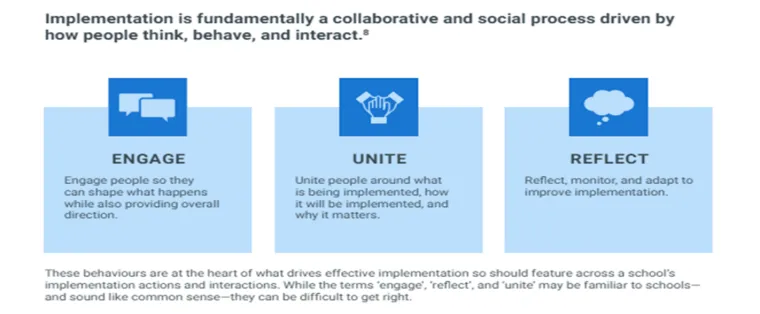
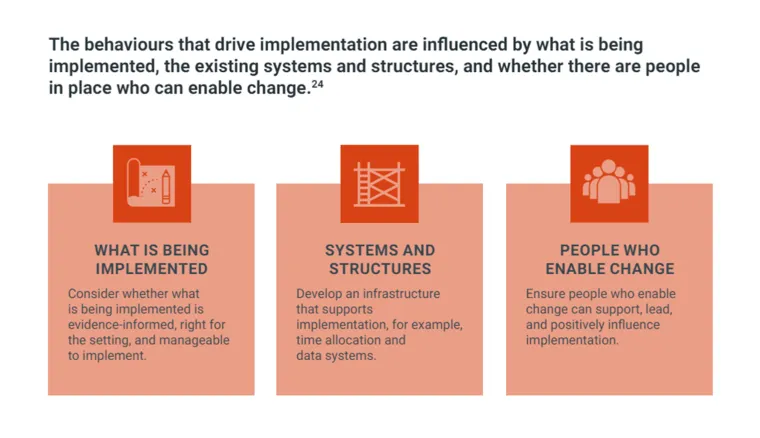
Recommendation 2- Attend to the contextual factors that influence implementation. This means needing to consider what is being implemented, developing a system and structure and supporting people to enable change.
Recommendation 3- Adapt a structured but flexible implementation process. It is important to use a evidence informed structure with some flexibility but with a clear strategic design.
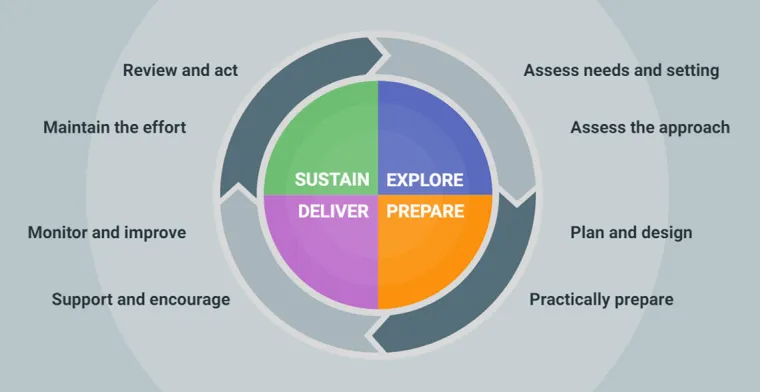
This model includes a set of practical implementation strategies that are organised into 4 flexible phases. This process emphasises that implementation of change unfolds over an extended period of time rather than being a single event or series of isolated events.
It is important to accept change is an ever-present part of our education system today. Research will not be able to provide all the answers to the difficulties change can present. However, it can provide useful supporting materials, to help you through your implementation journey.
Call to Action
Are your strategies for implementation of change needing adaption or restructure? Why not investigate further the suggested approaches to implementation?
Further reading
https://educationendowmentfoundation.org.uk/education-evidence/guidance-reports/implementation
https://www.ekrfoundation.org/5-stages-of-grief/change-curve/
https://www.kotterinc.com/methodology/8-steps/